Editor's note (July 11, 2026): This piece was written on April 13, 2026, at the height of the Hormuz crisis, with oil above $100 and the pump near $4.15. The shock has since drained out of the market. WTI trades around $72, US regular gasoline sits near $3.78, and our Route Disruption Index has eased to roughly 47. The crude relief did not reach the checkout cleanly, though. For where the pressure went and what stuck, read The Feather Finally Fell. The original April analysis follows unchanged.
There is a direct line between what happens in a 21-mile-wide channel off the coast of Iran and what you pay at the pump, the grocery store, and the checkout page of every online retailer. That line is getting shorter and more expensive by the day.
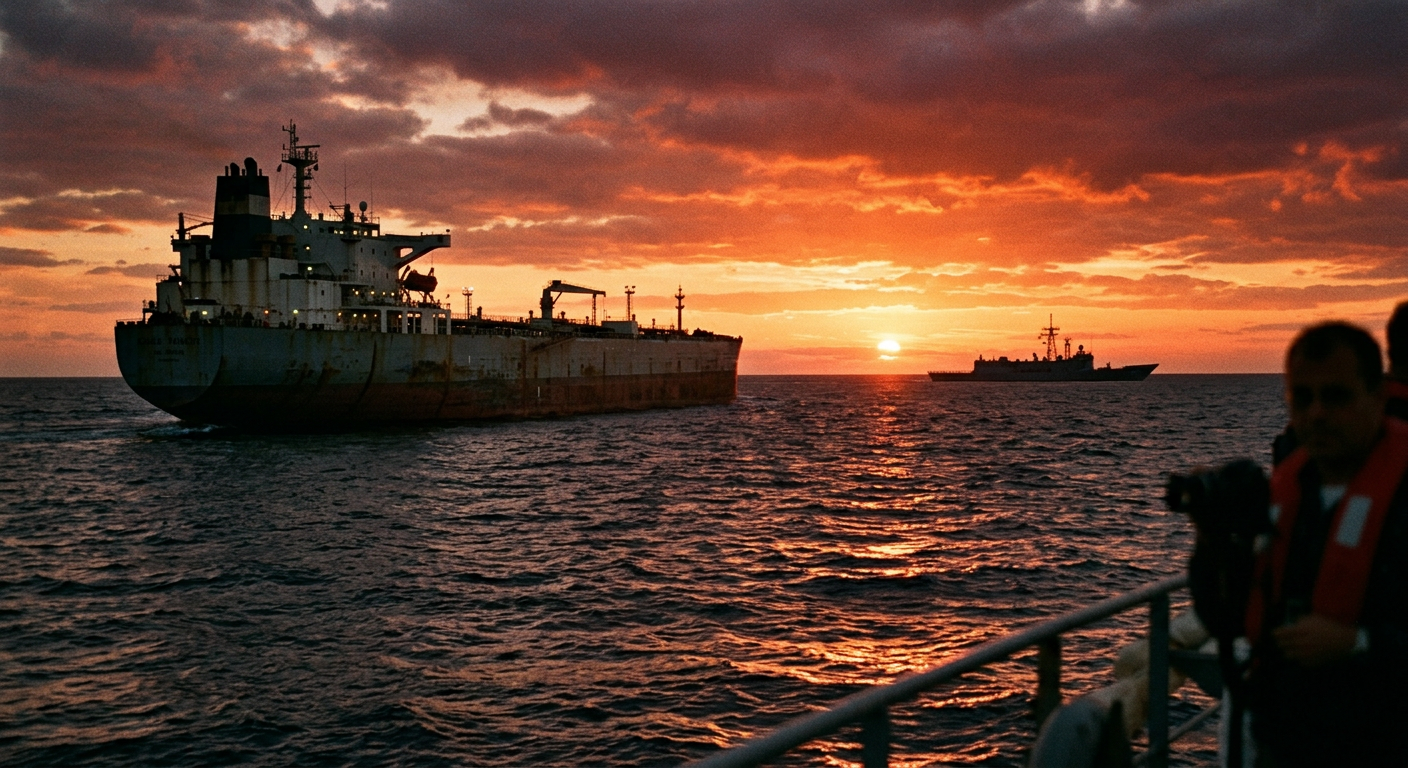
On February 28, 2026, the United States and Israel launched coordinated airstrikes against Iran under Operation Epic Fury. The military objectives were nuclear facilities and command infrastructure. The economic consequence was something far broader: the near-total disruption of commercial shipping through the Strait of Hormuz, the narrow passage between Iran and Oman through which roughly one-fifth of the world's oil supply and a quarter of its liquefied natural gas normally flow.
That was six weeks ago. The strait remains functionally blocked. Oil prices crossed $100 per barrel on April 12 when peace talks collapsed. U.S. gasoline has reached $4.15 per gallon nationally, with California already past $5. And the effects are only beginning to cascade through the economy.
The Transmission Mechanism: How Oil Becomes Groceries
Most people understand the direct connection between oil prices and gasoline prices. That transmission is fast — usually 7 to 14 days from a crude price spike to higher pump prices, because gasoline pricing is tied to futures markets that respond immediately to supply shocks.
But the grocery store connection is less obvious and more insidious. It works through three channels simultaneously.
Channel 1: Transportation costs. Nearly everything in a U.S. grocery store arrived by truck. Diesel fuel represents 25-35% of trucking operating costs depending on the carrier and route. When crude oil rises 40% — as it has since February — diesel follows. The Department of Energy's diesel price index has already climbed from $3.60 to $4.35 per gallon nationally. That cost gets passed through freight contracts with a typical lag of 30-60 days, which means the grocery price impact of today's fuel costs will arrive on shelves in May and June.
Channel 2: Agricultural input costs. Modern farming runs on petroleum derivatives. Fertilizer production requires natural gas. Farm equipment runs on diesel. Pesticides and herbicides are petrochemical products. Plastic packaging comes from oil. When crude prices spike, every link in the agricultural supply chain gets more expensive. This channel is slower — it takes 60 to 120 days to flow through planting, harvesting, processing, and distribution cycles — but it is also broader. It affects the price of virtually every food product.
Channel 3: Import cost inflation. The United States imports roughly 15% of its food supply by value. Much of that food travels by container ship, and container shipping fuel costs (bunker fuel) are directly tied to crude oil prices. The Hormuz disruption compounds this by also disrupting the Red Sea alternative route — shippers rerouting around the Cape of Good Hope add 10-14 days of transit time and roughly $1 million in additional fuel costs per voyage. Those costs land in the wholesale price of imported coffee, seafood, tropical fruits, olive oil, and cheese within one to two shipping cycles.
The Numbers: What This Means for a Typical Household
The average American household spent approximately $5,700 on groceries in 2025, or about $475 per month. Based on historical precedent from the 2022 energy-price shock and the IMF's 2026 research on shipping-to-inflation transmission, we estimate the following impacts from sustained $100+ oil:
Fuel: An immediate $40-60 per month increase in gasoline spending for a two-car household driving the national average of 13,500 miles per year. This is already happening.
Groceries: A 3-5% increase in food-at-home prices over the next 60-90 days, adding $15-25 per month to the average household grocery bill. The most affected categories will be dairy (heavy refrigerated transport), fresh produce (imported and fuel-intensive logistics), and meat (feed costs plus cold-chain logistics).
Household goods: A slower but broader 2-4% increase in consumer packaged goods as petrochemical input costs flow through manufacturing. Expect to see this in cleaning products, personal care items, and anything with plastic packaging by mid-summer.
The total hit: $70-100 per month for the average household if oil remains above $100 through Q2 2026. That is not a rounding error. For a family earning the median household income of roughly $80,000, it represents a 1.0-1.5% reduction in real purchasing power.
Why This Crisis Is Different from 2022
The 2022 energy price spike following Russia's invasion of Ukraine was severe, but the economic transmission was partially buffered by several factors that are weaker or absent now.
In 2022, the U.S. Strategic Petroleum Reserve held approximately 600 million barrels. The Biden administration released 180 million barrels over six months, which helped moderate gasoline prices during the worst of the crisis. Today, the SPR holds roughly 370 million barrels — still substantial, but the political appetite for another massive drawdown is constrained by the lessons of 2022 and the desire to maintain emergency reserves during an active military conflict.
In 2022, OPEC+ spare capacity provided a cushion. Saudi Arabia and the UAE could increase production to partially offset Russian supply disruptions. In 2026, OPEC+ spare capacity is thinner, and the geopolitical alignment is more complicated. Saudi Arabia's relationship with both the United States and Iran introduces diplomatic constraints on production decisions that did not exist in the Russia-Ukraine context.
In 2022, the Strait of Hormuz remained open. Global oil could flow freely through the Persian Gulf even as Russian exports were sanctioned. Today, the chokepoint itself is blocked. There is no easy reroute. Oil that normally transits Hormuz cannot simply take a different path — unlike container ships rerouting around the Cape of Good Hope during the Red Sea crisis, there is no geographic alternative for Gulf oil exports except through Hormuz or through limited pipeline capacity.
The Compounding Effect: Three Chokepoints Under Stress
What makes the current moment unusual in the history of maritime trade is that all three of the world's most critical shipping chokepoints are under stress simultaneously.
The Strait of Hormuz is functionally blocked, as described above.
The Red Sea and Suez Canal corridor is in a tentative recovery phase. Some carriers, notably Maersk, have resumed limited transits through the Suez Canal as of February 2026 following a partial ceasefire with Houthi forces. But others, including CMA CGM, continue routing via the Cape of Good Hope for certain services. Insurance premiums for Red Sea transit remain 5-10x above pre-crisis levels. The "recovery" is fragile and partial.
The Panama Canal continues to operate under drought-related restrictions. While not as severe as the 2023-2024 low-water crisis, daily transit slots remain below the historical average of 36-38 per day, creating scheduling delays and capacity constraints for vessels that might otherwise avoid the other two chokepoints.
The result is that global shipping has fewer safe, efficient routes than at any point in the modern era. Every alternative to a disrupted chokepoint leads to higher costs, longer transit times, and increased fuel consumption. Those costs compound through the supply chain and arrive at your doorstep.
What Happens Next
Three scenarios are worth tracking.
Scenario 1: Quick resolution (probability: low). A ceasefire agreement reopens Hormuz to commercial traffic within 30 days. Oil drops back to $75-80. Gasoline falls below $3.50 by June. Grocery price increases are moderate and temporary. This requires a diplomatic breakthrough that currently shows no signs of materializing.
Scenario 2: Prolonged disruption through Q3 (probability: moderate). The strait remains restricted through the summer. Oil averages $95-110 for the quarter. Gasoline stays above $4 nationally. Food inflation adds 0.5-0.8 percentage points to CPI by August. The Federal Reserve faces pressure to hold rates steady or cut more slowly than planned. Consumer spending softens, particularly among lower-income households who spend a larger share of income on fuel and food.
Scenario 3: Escalation (probability: non-trivial). The conflict broadens, additional infrastructure is damaged, or retaliatory actions further restrict Gulf oil exports. Oil spikes above $120. This scenario would likely trigger a recession and is outside the scope of normal price-impact analysis.
We will track all three scenarios through our indices. The Route Disruption Index and Household Fuel Risk Index are designed precisely for moments like this — to quantify the transmission of maritime disruption into household costs in near-real-time, rather than waiting for monthly government statistics to confirm what markets already know.
The Evidence Box
Key Finding: The Hormuz blockade has removed approximately 10 million barrels per day of oil transit capacity, driving crude past $100/barrel and gasoline to $4.15/gallon, with cascading effects expected to add 0.5-0.8 percentage points to food inflation within 60-90 days.
Supporting Data:
- Brent crude surged 10-13% in early March trading after strait restrictions reached 90%+ — Bloomberg
- U.S. gasoline national average: $4.15/gallon, California: $5.00+ — AAA, April 2026
- 20% of global oil and 25% of global LNG transits Hormuz — U.S. Energy Information Administration
- U.S. crude futures hit $104.80/barrel April 12 after peace talks failed — CNBC
- Full Hormuz normalization expected no earlier than July 2026 — CNN Business
Confidence Level: High
What Would Invalidate This Analysis: A rapid ceasefire immediately reopening the strait, or an SPR release large enough to offset the supply gap.