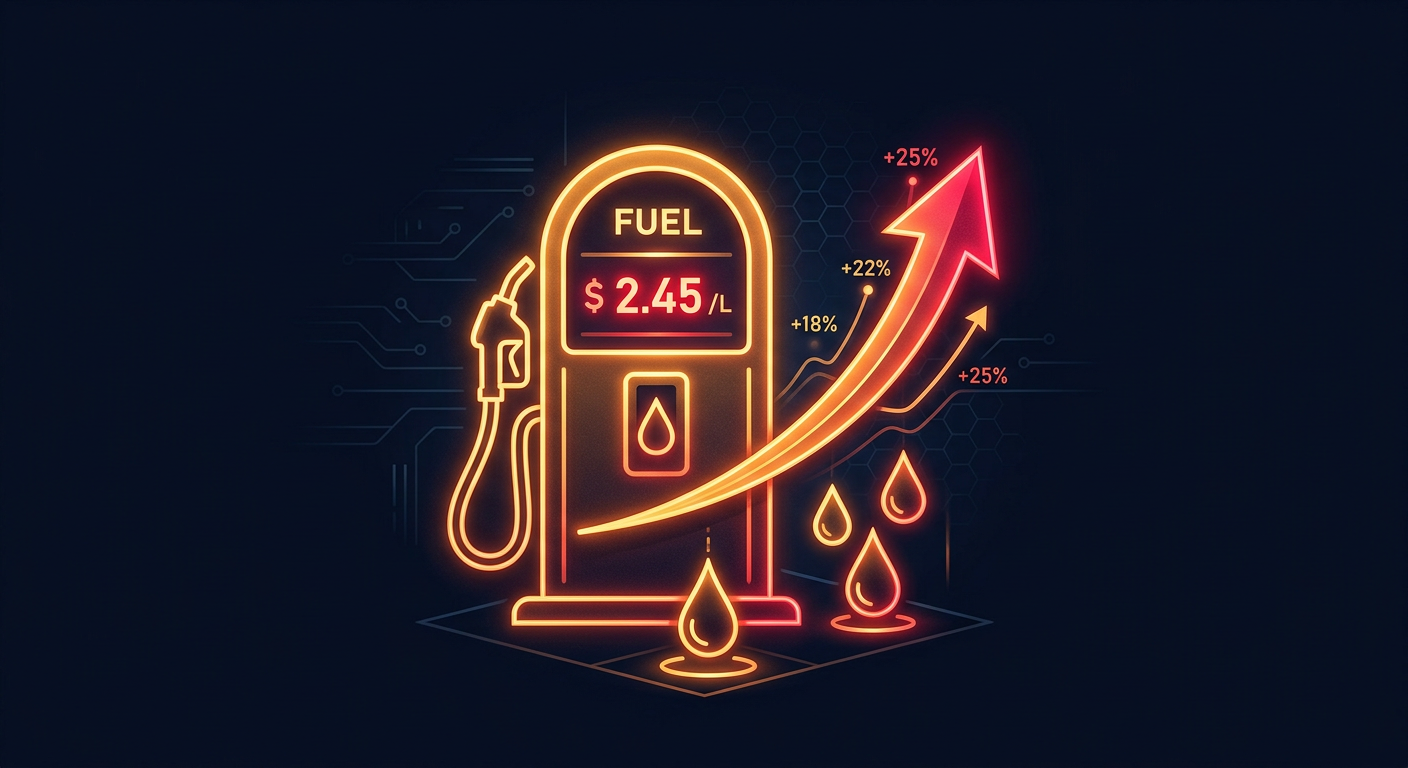
The oil shock that defined spring is over. Crude tells you so, freight futures tell you so, and our own Route Disruption Index, which read a near-panic 80.8 in April, has slid to 54 and briefly kissed 50.5 two days ago. By the logic most households carry in their heads, the gas station and the grocery aisle should be following crude down the hill. They are not. US regular gasoline sits at $4.05 a gallon, down a few cents from April. Coffee trades at 275 cents a pound. The CPI food index reads 348.9, parked near where it was when oil was thirty dollars higher.
That gap is the whole story. WTI fell about 27 percent from its April peak near $104 to $76.54. The pump fell maybe 2 or 3 percent. Put those two numbers next to each other and the asymmetry is almost comic: roughly a tenfold difference between how far the barrel dropped and how far the gallon followed. The barrel cooled. The bill didn't.
The shock that ended, on paper
Start with what actually de-escalated. The acute Hormuz episode that pushed Brent and WTI through triple digits in April has lost its grip on the oil price, even if it still owns the headlines. Middle East coverage logged 684 mentions across our news feed over the past seven days, more than any other region, so the strait is hardly forgotten. But the oil tape has stopped trading on it. WTI at $76.54 and Brent at $80.59 are roughly where prices sat before the spring spike, and natural gas at $3.20 is unremarkable.
Our Household Fuel Risk Index, which leans about 40 percent on crude and 30 percent on gasoline, has come down too, though more stubbornly: 64 today versus the low 80s in April. The reason HFRI lags crude is the same reason your gas bill lags crude, and it is worth sitting with that for a moment before assuming the index is broken. It isn't broken. It is measuring the pump, and the pump moves slowly.
The Route Disruption Index, which weights news 35 percent, chokepoint stress 30, freight 20, and crude deviation 15, has fallen furthest because three of its four legs eased at once. Crude reverted. The acute disruption premium drained out of the freight and news components. Over the past ninety days RDI ran a wide band, 49.4 to 80.8, and it now sits near the floor of that range. A system-stress gauge reading 54 is telling you the system has largely healed. A grocery bill reading "still high" is telling you something the system gauge cannot: relief and pass-through are not the same event.
Why the wellhead and the checkout run on different clocks
Crude oil is a financial instrument that happens to be flammable. It reprices by the second on a screen, and a Hormuz de-escalation hits that screen instantly. A gallon of gasoline in your tank, by contrast, is the end of a physical and contractual chain that takes weeks to flush. The crude bought today gets refined, shipped, stored, and sold over a span that the industry measures in weeks, not minutes, so the April barrel is still working its way onto June forecourts. Some of the relief is genuinely in the mail. But lag alone does not explain a tenfold gap, and anyone who tells you to just wait a few more weeks is only describing one of four forces, and the weakest one at that.
The second force is the one economists named after fireworks. Rockets and feathers is the documented tendency of retail fuel prices to shoot up like a rocket when crude rises and drift down like a feather when crude falls. Stations raise prices the day the wholesale cost ticks up because they are protecting margin against the next delivery; they lower them grudgingly, a penny at a time, because nobody volunteers to give back margin while customers are still paying. The asymmetry is not a conspiracy. It is the rational behavior of thousands of independent retailers who each face a sharper penalty for selling too cheap than for selling a few cents rich. Multiply that caution across a national network and the feather floats for weeks.
The freight ratchet is the third force, and the most underappreciated. When the strait scare hit, carriers priced in reroute risk, war-risk insurance, and bunker surcharges. Capacity was already tight, and a scare does not loosen it. Look at where freight benchmarks sit now that crude has cratered: the BDRY dry-bulk ETF near $11.57, ZIM at $24.34, SBLK at $25.81, none of them collapsing the way crude did. Shipping costs that ratchet up during a crisis tend not to ratchet back down on the same schedule, because the surcharges were written into contracts and the capacity that would compete them away was never there to begin with. A reroute premium booked in April rides inside the landed cost of a pallet of imported goods long after the reason for the reroute has faded from the news.
The fourth force is the quiet one, and it cuts the other way: oil is a smaller slice of your grocery bill than the pump-price drama suggests. Energy reaches a box of cereal through diesel in the delivery truck, plastic in the wrapper, and natural gas in the fertilizer that grew the grain, but those inputs are diluted by labor, packaging, marketing, retail margin, and the farmgate price of the commodity itself. So when crude falls 27 percent, the oil-linked portion of a grocery item might fall by that much, but that portion is small, and it arrives slowly, and it lands on top of food-commodity prices that have their own weather and supply stories. Coffee at 275 cents is not waiting on a barrel of WTI. It is waiting on Brazilian rain and a tight global balance.
The Checkout Index: a gauge built for exactly this gap
This is the moment the Checkout Index was designed for. RDI measures whether the maritime system is under stress. HFRI measures fuel risk at the household level. Neither answers the question a shopper actually asks, which is simply: how much more is this week costing me than a normal week? The Checkout Index does. It blends a fuel score, a grocery score, food-CPI and agricultural-futures signals, and a freight component, weighting groceries 45 percent, fuel 40, and freight 15, then expresses the result in dollars above the five-year norm.
Today it reads about 60, squarely in the Elevated band, with the fuel premium running roughly $7 a week above where a typical pre-shock week would land. That $7 is the residue of everything above: the feather still floating down at the pump, the freight surcharges still riding inside landed costs, and food commodities holding their own line. It is a small enough number that no single shopping trip will scream it at you, and a persistent enough number that it compounds into real money across a quarter. Seven dollars a week is roughly $360 a year for one household, drawn almost entirely from the gap between what crude says prices should be and what the checkout actually charges.
The value of putting a dollar figure on it is that it refuses to let the headline off the hook. "Oil is back to normal" is true and useless to a family at the register. The Checkout Index says: the system relaxed, your week did not, and here is the size of the difference.
The non-obvious part
Here is the insight the raw data hides. The conventional read is that consumers are simply waiting for a lagged pass-through, that the feather will eventually land and gas will drift toward $3.70 as the April barrels clear. Part of that is real. But the freight component argues that a meaningful slice of today's elevated checkout cost is not a lag at all. It is a permanent re-leveling that will not reverse, because tight shipping capacity and crisis-era surcharges have reset the floor under landed costs. When you decompose the roughly $7 weekly premium, the fuel piece is the part that should eventually erode as the pump catches down to crude. The freight-and-staples piece may not. That distinction matters: it means the back half of this premium is less a delay than a new baseline, and households waiting for prices to "go back" may be waiting on a reversion that the shipping market has quietly priced out.
Which reframes the whole episode. The spring shock did not just spike prices and recede. It walked the cost floor up a step and left it there. Crude came home. The floor stayed.
What to watch
Three markers will tell you whether the feather is finally landing or the ratchet is holding.
Gasoline first. If US regular breaks below roughly $3.70 a gallon over the next four to six weeks, the rockets-and-feathers lag is closing on schedule and the fuel slice of the Checkout Index should drain toward normal. If it sticks near $4 while crude stays around $76, the feather is winning, and that argues the re-leveling is structural rather than transitional.
Panama next. We are in wet season, transits are running near normal at roughly 33 a day, and the canal's drought index has eased. A wet season that holds keeps a reroute premium off Pacific-basin freight and takes pressure off the Checkout Index's shipping leg. A sudden dry spell would do the opposite, fast.
Coffee last, as the cleanest tell that food has its own clock. With the bean near 275 cents, watch whether it finds a floor or keeps grinding higher on supply news that has nothing to do with any strait. If coffee holds its line while oil sits quiet, that is the grocery aisle reminding you, one cup at a time, that the barrel was never the whole story.