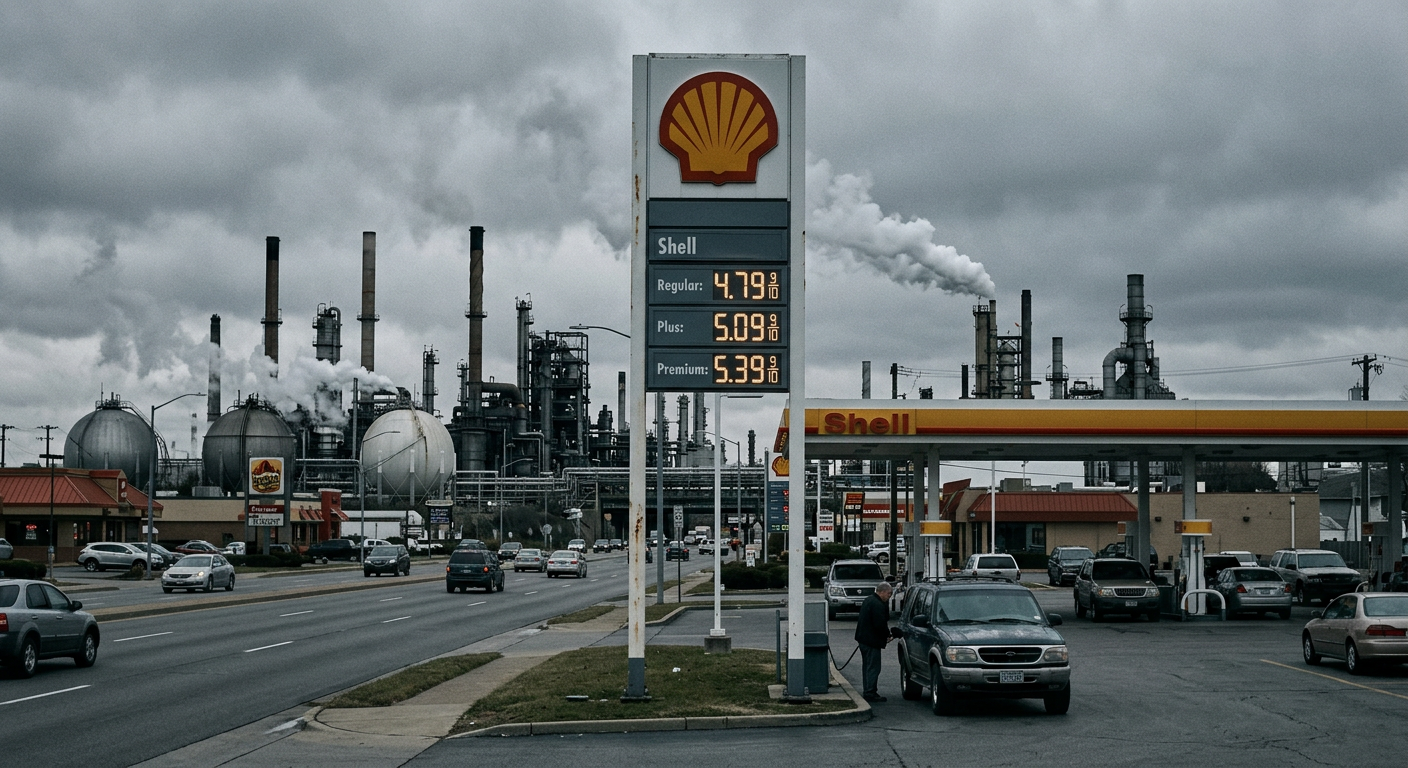
Operation Epic Fury and the Price at the Pump: Week Four
Four weeks into Operation Epic Fury, the first verdict from energy markets is clear enough. The world has not yet entered a 1970s-style oil panic. It is, however, paying a sizeable disruption tax. The Strait of Hormuz, still operating at barely a fraction of normal volumes after the February 28 strikes on Iran, has removed roughly 17m-20m barrels a day from normal seaborne movement. Brent crude has risen to $92 a barrel from $75. WTI has moved to $89 from $75. Average American gasoline has climbed to $3.96 a gallon from $3.01.
That is not a financial-market scare. It is a consumer shock already in motion.
The market’s month-one move contains two messages. First, traders believe the outage is serious but not permanent. A sustained loss of close to one-fifth of global oil supply would put prices far above current levels. Second, even a temporary blockage of Hormuz is enough to lift household energy bills quickly, because retail fuel responds to global oil prices, not to the source of crude consumed by any one country. America can produce most of its own crude and still pay more at the pump. Oil remains a world price.
The arithmetic is straightforward. Crude accounts for roughly half to three-fifths of the retail gasoline price in the United States, with refining, distribution, marketing and taxes making up the rest. When Brent rises by nearly a quarter in four weeks, wholesale gasoline and diesel tend to follow within days. Retail stations move more slowly because they are selling from existing inventories and because local competition matters. But the lag is measured in weeks, not months. The rise from $3.01 to $3.96 a gallon — about 32% — is consistent with that pattern. For a driver buying 15 gallons, that is an extra $14.25 a fill-up. For a two-car household burning 90 gallons a month, it is roughly $85 of added monthly cost before any rise in airfares, delivery charges or food.
The shock has travelled through several channels at once. The first is physical supply loss. Hormuz handles exports from Saudi Arabia, Iraq, Kuwait, the UAE and Qatar, along with residual Iranian flows. The second is shipping friction. War-risk premiums, higher crew costs and tanker scarcity raise the delivered cost of crude even when cargoes can move. The third is refinery economics. Not every barrel is interchangeable. When medium and sour grades from the Gulf become harder to obtain, refiners bid up alternatives from the Atlantic basin, West Africa and the Americas. That can widen product margins, especially for diesel and jet fuel. The fourth is expectation. Buyers do not wait for tanks to run dry; they pay up when forward supply looks less secure.
This is where OPEC+ spare capacity matters, and where the headline number misleads. On paper, the group still has several million barrels a day of idle production, much of it in Saudi Arabia and the UAE. On the water, what matters is deliverable spare capacity outside the blocked chokepoint. Saudi Arabia can reroute some crude westward through the East-West pipeline to Yanbu on the Red Sea. The UAE can use the Abu Dhabi-to-Fujairah pipeline to move some barrels outside Hormuz. But those bypasses are finite and were not sitting empty. Kuwait, most Iraqi Gulf exports and almost all Qatari LNG do not enjoy equivalent relief. The practical buffer is therefore far smaller than the headline spare-capacity figure. In month one, that has capped panic without restoring normality.
The comparison with Russia’s invasion of Ukraine in 2022 is useful precisely because the disruptions differ. In 2022 the initial shock came from sanctions risk, self-sanctioning by traders, and the forced rewiring of Russian exports away from Europe. Prices leapt because a major producer had become politically toxic, but the barrels themselves did not vanish overnight. Over time, Russia found new buyers. Freight distances grew. Europe paid a heavy premium for diesel, gas and replacement crude. This time, by contrast, the loss is more visibly maritime and more immediate. A chokepoint has narrowed. The volume at risk is larger at the front end. Yet the price reaction after four weeks is still smaller than the 2022 peak, when Brent ran above $120.
Why? Partly because the market expects a shorter disruption. Partly because strategic inventories and commercial stocks are higher than in earlier crises. Partly because demand growth in 2026 was already softening under slower global manufacturing and high tariffs. And partly because North American supply remains flexible. A shale barrel from Texas does not replace a Gulf sour barrel one-for-one, but it does keep total balance tighter rather than broken.
America’s relative strength in crude production does not mean insulation. U.S. refiners buy and sell into a global product market. Gulf Coast plants can process domestic shale, Canadian heavy crude and Latin American grades, but replacement costs still rise when seaborne markets tighten. East Coast fuel consumers are even more exposed to import pricing and shipping rates. The result is a broad increase in rack prices that works through retail stations with regional variation rather than a neat national average. In some states, prices have moved faster than the benchmark; in others, local taxes and prior inventories have softened the first month’s hit. None of that changes the trend.
The wider consumer basket is now beginning to feel the second-round effects. Airlines hedge some fuel, but not indefinitely. Freight carriers impose surcharges. Petrochemical feedstocks become more expensive, feeding into packaging, plastics and industrial inputs. Fertilizer costs are sensitive to gas and liquids markets, which matters for food prices later in the year. The direct effect of gasoline on U.S. inflation is the first wave. The indirect effect arrives with a lag of one to three months.
That lag matters for April. American refineries are entering the spring switch to summer-grade gasoline, which is costlier to produce and usually lifts pump prices even without a crude shock. Maintenance season also trims refinery runs at the wrong moment. If crude merely holds at current levels, retail gasoline can still grind higher through April as higher wholesale costs work through inventories and seasonal specifications bite. If Brent falls back sharply on a credible reopening of Hormuz, the pump will not instantly follow. If Brent rises further, retail prices will.
Shipping disruptions elsewhere are making the bill larger. The Red Sea has partially recovered, but only partially. Some operators have resumed transits under escort or selective risk appetite; many still prefer the Cape route. That keeps voyage times longer and ties up tonnage. Panama Canal drought restrictions continue to limit efficient scheduling for container ships, LPG carriers and some refined-product movements. Add a Hormuz blockage on top and the global shipping system loses slack. Tankers spend more days at sea. Insurance remains expensive. Freight rates embed a security premium. By the time a barrel becomes a gallon, the logistics bill is visibly higher.
Tariffs are adding a separate cost channel. With U.S.-China tariffs in the 30%-55% range, importers of consumer goods already have less room to absorb transport increases. Higher ocean freight, higher fuel surcharges and higher duties now hit the same invoice. That does not move the pump directly, but it does make the broader inflation picture harder. In 2022 the energy shock hit goods prices during a period of supply-chain normalisation. In 2026 the world enters the shock with trade frictions still elevated and major routes still constrained.
For now, the key restraint on prices is duration. The market is still treating the closure as a severe but temporary interruption. That assumption may prove right. If diplomatic pressure, convoy protection and emergency repairs reopen Hormuz even partially in early April, Brent could retreat into the low-to-mid $80s while U.S. gasoline stays high for another fortnight before easing. If the blockage persists through April with exports still down by more than 70%, the balance changes. Strategic releases can smooth the path, not erase the deficit. In that case Brent testing $100-$110 would be the central case, not the tail risk. A broader hit to Gulf production or export infrastructure would put 2022’s highs back in view.
Risk and Route’s base case for April is therefore one of continued consumer pressure rather than immediate escalation into outright shortage. The month-one data point is less about empty stations than about persistent pass-through. Energy shocks rarely arrive as a single jump and then stop. They move along pipelines, through refinery tanks, across tanker routes and into freight contracts. The first month has established the direction. The second month will determine the scale.
For households, the message is simple. The rise to $3.96 a gallon is not the end of the move unless the waterway reopens quickly and convincingly. For policymakers, the message is less comfortable. Headline spare capacity is not the same as accessible spare capacity. A blocked chokepoint can leave millions of nominal barrels stranded behind it. For shippers and retailers, the lesson is familiar from the past few years: when several bottlenecks tighten at once, each one becomes more expensive than it would be on its own.
Evidence box
Key finding: After four weeks, Operation Epic Fury has produced a broad but still manageable energy shock: large enough to lift U.S. gasoline by nearly one-third, not yet large enough to signal a prolonged global supply collapse.
Five data points:
- Strait of Hormuz flows remain down by more than 90% from normal levels.
- Roughly 17m-20m barrels a day of oil supply has been removed from normal movement.
- Brent crude has risen to $92 a barrel from $75 since February 28.
- WTI has risen to $89 a barrel from $75 over the same period.
- U.S. regular gasoline has risen to $3.96 a gallon from $3.01, a gain of about 32%.
Confidence: Medium-high. The first-month price pass-through is observable. Uncertainty rests mainly on outage duration, the usable share of OPEC+ spare capacity, and the scale of emergency stock releases.
What invalidates this view: A rapid and credible reopening of Hormuz; a coordinated strategic-stock release large enough to offset several million barrels a day for multiple months; evidence that Saudi and UAE bypass routes can move far more crude than current estimates imply; or a sharp global demand setback that cuts oil consumption faster than the disruption cuts supply.