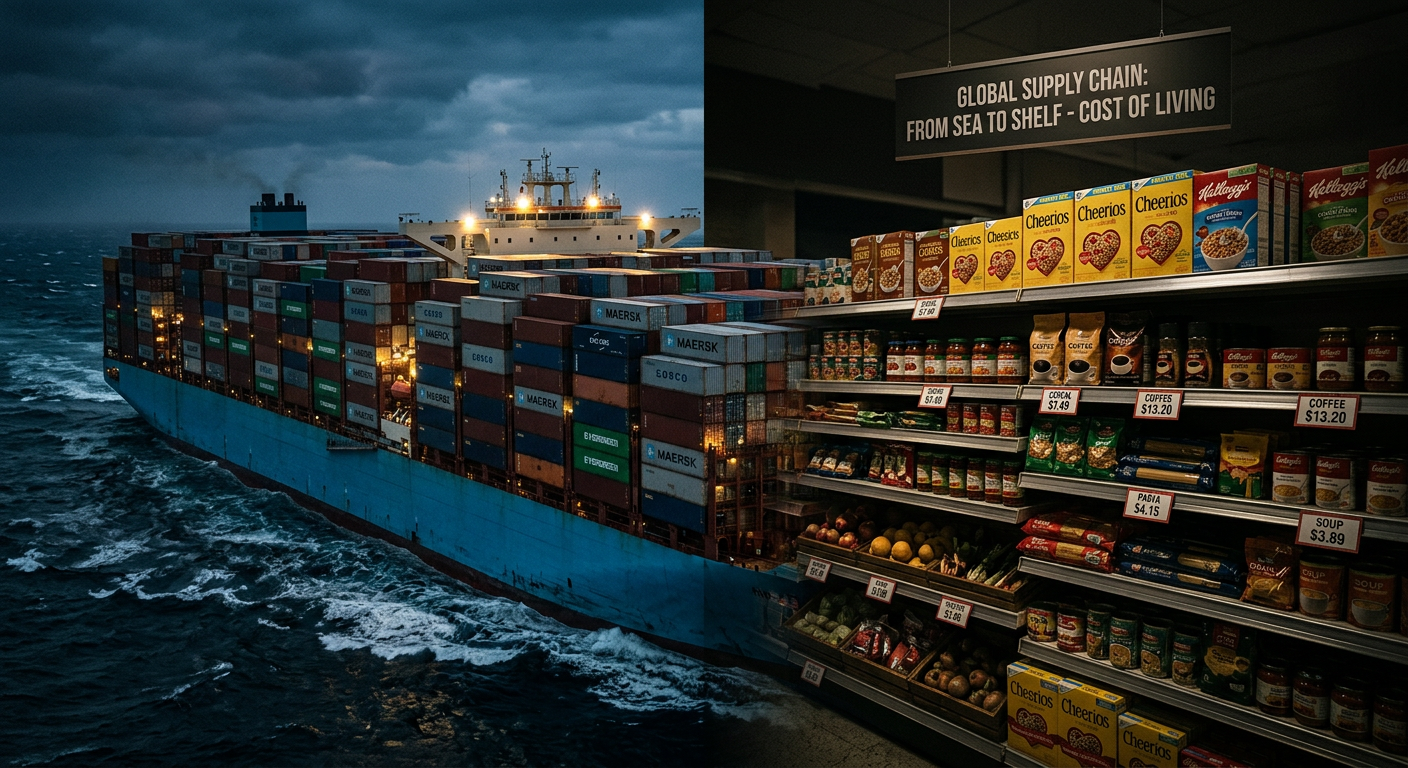
Most people think of tariffs and shipping costs as separate problems. They are not. They are the same problem, compounded.
This is the mechanical reality now facing every American business that imports goods from China — and every consumer who buys what those businesses sell. The United States has stacked tariffs on Chinese imports to a cumulative rate of 30% to 55% depending on the product category. Simultaneously, the cost of moving a container from Shanghai to Los Angeles has roughly doubled since late last year, driven by a cascade of disruptions that have no near-term resolution. These two forces do not merely add together. They multiply. And the multiplication produces price increases that will be visible on retail shelves within sixty days.
The Tariff Stack: How 55% Happens
The current US-China tariff structure is the product of three distinct policy actions layered on top of each other.
The oldest layer is the Section 301 tariffs, originally imposed in 2018 under the first Trump administration and maintained through the Biden years. These cover a broad swath of Chinese imports at rates of 7.5% to 25%. The highest rates — 25% — apply to electronics components, industrial machinery, furniture, and a long list of consumer goods.
On top of that, the fentanyl-related tariffs imposed in early 2025 added 20% to virtually all Chinese imports. The rationale was punitive: the surcharge was designed to pressure China on precursor chemical exports. Whether it has achieved that goal is debatable. What is not debatable is that it raised the duty rate on Chinese goods by 20 percentage points across the board.
The third layer is the baseline 10% tariff applied to all imports from countries subject to the general tariff schedule revisions of February 2025.
For products that fall under the highest Section 301 bracket, the math stacks to 55%. A television, a laptop, a piece of flat-pack furniture, a washing machine — all of these arrive at U.S. customs with a duty bill that adds more than half again to their value.
This alone is significant. But what makes the current moment dangerous is not the tariff rate in isolation. It is the interaction between the tariff rate and a shipping market that is simultaneously broken.
The Shipping Crisis: Three Chokepoints, One Bill
Container shipping rates from China to the U.S. West Coast are currently running between $3,400 and $5,000 per 40-foot equivalent unit (FEU). In late 2025, the same route cost $1,800 to $2,200. The near-doubling is the result of three simultaneous disruptions.
The Strait of Hormuz has been effectively blocked since the launch of Operation Epic Fury on February 28. The direct impact on container shipping is limited — Hormuz is primarily an oil and LNG corridor, not a container route. But oil prices have climbed to $88 per barrel, and that translates directly into higher bunker fuel costs for every container vessel on every route worldwide. Bunker fuel surcharges, which carriers impose as a pass-through, have risen 15-20% across the major trans-Pacific services.
The Red Sea corridor remains risky. Maersk and some other carriers have tentatively resumed limited Suez Canal transits, but war-risk insurance premiums are still five to ten times the pre-crisis baseline. CMA CGM continues to route some Asia-Europe and Asia-U.S. East Coast services via the Cape of Good Hope, adding 10 to 14 days and roughly $1 million in fuel per voyage. That cost gets allocated across the containers on board.
The Panama Canal is operating below historical capacity due to ongoing drought restrictions. Daily transits remain below the 36-38 per day average. Ships that might use the Pacific-to-Atlantic Panama route as an alternative to Suez face queue delays and draft limitations.
The net result: there is no cheap way to move a container from China to the United States right now. Every route is either longer, more expensive, or both.
The Multiplier Effect: Why Tariffs Make Shipping Costs Worse
Here is the mechanism that most reporting misses, and it is the reason the current situation is more punishing than either tariffs or shipping costs alone would suggest.
U.S. customs duties are assessed on the declared value of imported goods — typically the price paid to the foreign manufacturer, plus certain costs including freight. When shipping costs rise, they increase the declared value. The tariff is then applied to the higher base. The tariff, in other words, acts as a multiplier on the shipping cost increase itself.
Work through a specific example. A Chinese manufacturer sells a home appliance to a U.S. importer for $200. Under normal conditions, the freight cost allocated to that unit is $15. The landed cost before duty is $215. At a 55% tariff rate, the duty is $118.25. Total landed cost: $333.25.
Now the same appliance in March 2026. The manufacturer's price is still $200. But the per-unit freight allocation has doubled to $30 because container rates have jumped from $2,000 to $4,500 and fuel surcharges have added another layer. The landed cost before duty is now $230. The 55% tariff on $230 is $126.50 — that is $8.25 more in duty than before, triggered entirely by the shipping cost increase. Total landed cost: $356.50.
The importer's cost has risen by $23.25 — of which $15 is the raw shipping increase and $8.25 is the tariff's amplification of that increase. The tariff turned a $15 shipping cost increase into a $23.25 total cost increase. That is a 55% multiplier on every additional dollar of freight.
Scale this across a full container. A 40-foot container carrying $150,000 worth of electronics at the manufacturer's door now costs an additional $2,000-$3,000 in freight compared to six months ago. The tariff amplifies that freight increase by 30-55% depending on the product category, adding another $600-$1,650 in duty. For a single container, the combined freight-plus-tariff-multiplier increase is $2,600 to $4,650. Multiply by the roughly 800,000 containers that arrive from China each month, and the aggregate cost flowing into the U.S. consumer economy is staggering.
Which Products Get Hit Hardest
Not all imports are equally affected. The damage concentrates where three conditions overlap: high tariff rates, high volume, and high weight-to-value ratios.
Consumer electronics. Laptops, monitors, printers, small appliances, audio equipment. These face the full 55% tariff stack and are shipped in enormous volumes. A typical 40-foot container carries $200,000-$400,000 worth of consumer electronics. The tariff multiplier on shipping costs adds $3,000-$5,000 per container. At the retail level, expect 15-25% price increases on mid-range electronics by May.
Large appliances. Washing machines, refrigerators, air conditioners. These products have high weight-to-value ratios, meaning freight costs represent a larger share of their total landed cost. A container of washing machines might hold 50-60 units worth $300-$500 each at the factory gate. The per-unit freight increase of $40-$60, amplified by the tariff multiplier to $55-$85, lands on a product where a $50 price increase is immediately visible to consumers.
Furniture. Flat-pack and assembled furniture from China faces 25-55% tariffs depending on material and classification. Furniture is bulky and heavy — it fills containers by volume before it fills them by weight — which means high per-unit freight costs. A sofa that costs $400 at the factory might carry $80-$120 in freight under current conditions, up from $40-$60 six months ago. After the tariff multiplier, the landed cost increase is $55-$90 per piece.
Household goods. Cookware, storage containers, lighting, tools, hardware. The aggregate impact across dozens of small purchases is less visible per item but adds up. An American household buying $2,000 worth of Chinese-manufactured household goods annually will pay $300-$500 more in 2026, mostly without noticing any single price jump.
The Small Importer Problem
Large retailers — Walmart, Amazon, Home Depot — have the scale to absorb or negotiate some of these costs. They book container space months in advance at contracted rates. They can shift sourcing to Vietnam, India, or Mexico (though this takes 12-18 months to execute meaningfully). They have the financial capacity to eat margin compression temporarily while waiting for costs to stabilize.
Small importers have none of these advantages. A business importing 10-20 containers per year from China is buying space on the spot market, where rates are highest. They lack the volume to negotiate carrier discounts. They cannot afford to hold six months of inventory as a buffer against rate volatility. And they typically have thinner margins to begin with, meaning the tariff-shipping multiplier pushes them toward unprofitability faster.
The arithmetic is straightforward. A small importer paying $4,500 per container on the spot market (up from $2,000) and facing a 55% tariff on goods that sold at 30% margins is now looking at margins of 8-12% — before accounting for domestic freight, warehousing, and overhead. Some categories go negative. A small furniture importer told industry publication Supply Chain Dive in early March that two of his five best-selling product lines are now unprofitable to import. He is either raising prices 30% or discontinuing the lines. His customers — regional furniture stores across the Southeast — will either pay more or stock fewer options.
This consolidation pressure is a feature, not a bug, of the tariff-shipping squeeze. Smaller players exit. Larger players absorb market share. Product variety shrinks. Prices rise. The consumer pays.
The Q2 2026 Price Timeline
The effects of the current tariff-shipping squeeze will arrive at retail shelves on a predictable schedule, governed by the transit times, inventory buffers, and repricing cycles of the American retail system.
Now through mid-April. Retailers are selling through inventory ordered at lower rates in Q4 2025 and early Q1 2026. Prices at shelf are mostly stable. This is the deceptive calm.
Late April through May. The first containers booked at current elevated rates begin arriving at U.S. ports. Retailers restock at higher landed costs. The most price-sensitive categories — off-brand electronics, budget furniture, imported tools and housewares — reprice first. Expect 10-15% increases in these segments.
June through July. The full impact arrives. Goods ordered in March and April at peak tariff-plus-shipping costs reach shelves. Major retailers adjust prices across broader categories. Consumer electronics, appliances, and home furnishing see 15-25% increases compared to January 2026 levels. Promotional pricing and discounts become less frequent as margin pressure constrains retailers' ability to absorb costs.
August onward. If the shipping disruptions persist and tariffs remain unchanged — both of which are the base case — the elevated cost structure becomes the new normal. Back-to-school electronics purchases, fall home improvement projects, and early holiday shopping will all occur at materially higher price points.
What Would Change the Trajectory
Two developments could ease the squeeze. Neither is likely in the near term.
First, a bilateral tariff reduction. The fentanyl surcharge was designed as a pressure tool, which implies it could be negotiated away. But no serious talks are underway, and the political dynamics of 2026 — a midterm election year with trade policy as a central issue — make unilateral tariff concessions politically radioactive. The Section 301 tariffs have survived two administrations. They are, for practical purposes, permanent.
Second, a shipping cost normalization. This requires resolution of at least two of the three chokepoint crises. The Hormuz blockade is three weeks old with no diplomatic path visible. The Red Sea recovery is fragile. The Panama Canal drought is a climate problem with no policy solution. Container rates are more likely to rise further than to fall in Q2.
The probability of both developments occurring simultaneously is low enough that importers, retailers, and consumers should plan for the current cost structure to persist through 2026.
The Bottom Line
The tariff-shipping double squeeze is not a theoretical risk. It is an arithmetic certainty already moving through the supply chain. A 55% tariff does not merely tax imports — it amplifies every other cost increase that touches those imports. When shipping rates double, the tariff turns that doubling into something closer to tripling at the landed cost level. When fuel surcharges rise, the tariff magnifies them. When insurance premiums spike, the tariff takes its cut of the spike.
For American consumers, the result will be visible by late spring: higher prices on electronics, appliances, furniture, and the broad category of imported household goods that fills homes from the kitchen to the garage. The increases will not be uniform — some categories will jump 15%, others 30% — but the direction is unambiguous.
The lesson, if there is one, is that trade barriers and supply chain disruptions are not independent variables. They are a system. And in 2026, that system is producing the most expensive import environment in a generation.