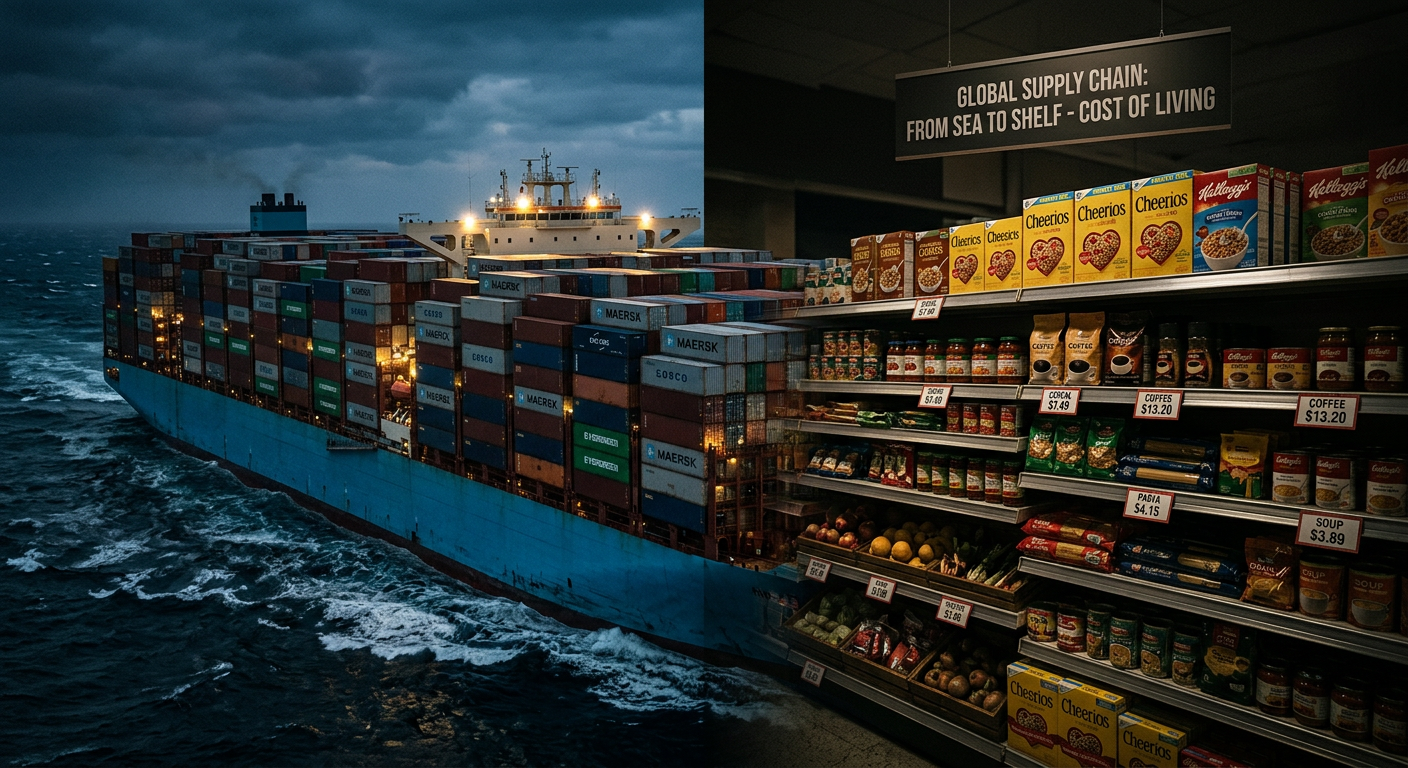
There is a receipt sitting on a kitchen counter somewhere in America right now that tells a story about the Strait of Hormuz. The person who paid it probably has no idea.
It is a Walmart receipt. The paper folders on it cost 46% more than they did six months ago. The fish fillets are up 34%. The plastic measuring spoons are up 19%. The total at the bottom is higher than expected, and the explanation involves a 21-mile-wide channel between Iran and Oman that most Americans could not locate on a map.
This is not an abstraction. It is not a line on a shipping industry dashboard or a number in an economist's working paper. It is money leaving your wallet faster than it was last year, and the reasons are traceable, specific, and worth understanding.
The Three Forces Hitting Your Receipt Simultaneously
There are three distinct cost pressures converging on American retail shelves right now. Each one alone would be noticeable. Together, they are producing the largest cost-of-living squeeze since 2022.
Force 1: The tariff stack. US tariffs on Chinese goods now total 30-55% depending on the product category. That is 25% from the original Section 301 tariffs, plus 20% from the fentanyl levy, plus a 10% baseline tariff. The average US tariff rate on all imports sits at 16.9% -- the highest since 1932. When a Walmart buyer sources a $3 package of measuring spoons from a factory in Guangdong, that $3 becomes $4.65 before it even reaches the port. When shipping costs also rise, the tariff multiplies those too. A $0.30 increase in shipping cost per unit becomes $0.47 after tariffs.
Force 2: The Hormuz oil shock. Since Operation Epic Fury began on February 28, crude oil has risen from $75 to $104 per barrel. Gasoline hit $4.00 per gallon on March 31 and now sits at $4.15 nationally. This hits retail pricing through three channels: diesel fuel for trucking (25-35% of freight costs), energy for refrigeration and store operations, and petrochemical inputs for packaging. A gallon of diesel has gone from $3.60 to $4.35, and every truck that delivers goods to every Walmart, Target, and Dollar General in America runs on diesel.
Force 3: The fertilizer squeeze. This one is less obvious but arguably more consequential for grocery prices. Over a third of the world's seaborne fertilizer transits the Strait of Hormuz. Urea prices have spiked 35% since the blockade began. Fertilizer is the single largest variable cost in modern farming after land. When urea costs 35% more, corn costs more. When corn costs more, animal feed costs more. When animal feed costs more, chicken, beef, pork, eggs, and dairy all cost more. This channel operates with a 60-90 day lag, which means the fertilizer price spike from March is hitting farm budgets now and will reach grocery shelves by late May.
What the Big Retailers Are Actually Saying
The most revealing data comes not from government statistics but from corporate earnings calls, where executives speak to investors with a candor they rarely show consumers.
Walmart's CFO told analysts that general merchandise inflation rose from 1.7% to over 3% between Q3 and Q4, and that "tariff costs are rising each week." The company has been selective about which products to reprice, absorbing margins on staples while passing through costs more aggressively on discretionary items. Walmart's strategy is to stay cheaper than competitors even while raising prices, which means Target and smaller retailers face even steeper increases.
Target has been more explicit about the pain. Their earnings guidance for 2026 flagged "significant cost headwinds" from tariffs and shipping, and the company acknowledged that price increases of up to 10% are likely across general merchandise categories.
Dollar General is arguably the most vulnerable. Their entire business model depends on selling cheap imported goods to price-sensitive consumers. When tariffs add 30-55% to the cost of Chinese imports and shipping costs rise 20-30%, the dollar store math breaks. Dollar General has already been quietly raising price points from $1.25 to $1.50 and $2.00, effectively breaking the psychological price ceiling that defines the brand.
Costco, characteristically, is taking a different approach. They are accelerating local sourcing of Kirkland products specifically to avoid tariff exposure and reduce shipping cost sensitivity. It is a smart strategic move, but it only works for products that can be manufactured domestically, which excludes most electronics, many household goods, and a significant portion of their apparel and seasonal inventory.
The CNBC Receipt Analysis
The most specific data on real-world price changes comes from a CNBC analysis that tracked Walmart prices on over 100 items. The results are striking:
The largest increases were concentrated on products imported from countries with the heaviest tariff burden. Chinese-made goods showed the most dramatic jumps: store-brand paper folders up 46%, Farberware measuring spoons up 19%. Vietnamese imports were also hit hard: swai fish fillets up 34%, reflecting both tariff costs and elevated shipping rates on the Asia-US route.
But the increases are not uniform. Domestically produced staples like milk, bread, and eggs have seen more modest increases of 2-5%, driven primarily by diesel and fertilizer costs rather than tariffs. This creates a visible split on the receipt: the groceries got a little more expensive, the imported household goods got a lot more expensive.
The Grocery Aisle: What Is Coming
The USDA projected 3.6% food price increases for 2026 before the Hormuz crisis began. That number is now almost certainly too low.
The produce section is being hit first. Tariffs on Colombia, Peru, and Costa Rica are raising costs on avocados, coffee, bananas, and cut flowers. The Hormuz fertilizer disruption is pushing up costs for domestic produce that relies on nitrogen-based fertilizer. And diesel-driven transportation costs are adding 2-4% to the price of everything that travels by refrigerated truck -- which is nearly all fresh food.
The meat counter is next. The 35% urea spike flows through to animal feed costs within one growing cycle. Chicken producers, who operate on thin margins and fast turnover, will be the first to raise prices. Beef follows with a longer lag because cattle take longer to reach market weight. The USDA's livestock price forecasts will likely be revised upward in the May report.
Dairy is the sleeper category. Milk production is energy-intensive (refrigeration at every stage from farm to store) and feed-cost-sensitive. A 35% fertilizer increase plus a 20% diesel increase produces a dairy price squeeze that reaches consumers within 60 days. Expect milk, cheese, and yogurt prices to rise 4-7% by June.
What Costco Knows That You Should Know
Costco's move to accelerate domestic sourcing is not just a tariff strategy. It is a signal about the duration of the current disruption.
Companies make supply chain changes on this scale only when they expect the cost environment to persist for 12-24 months minimum. Reshoring supply chains, qualifying new domestic suppliers, and restructuring procurement contracts are expensive and slow. Costco would not be doing this if they expected tariffs to drop or the Hormuz crisis to resolve quickly.
When the largest and most operationally sophisticated retailer in America starts rebuilding supply chains around maritime disruption, that is an indicator. It says: the people with the best data expect this to last.
The Dollar Amount: What This Means for a Household Budget
The average American household spent approximately $475 per month on groceries in 2025. Based on the convergence of tariff pass-through, fuel cost transmission, and fertilizer-driven agricultural inflation, we project the following increases through Q3 2026:
Groceries: +$15-25 per month (3.6-5.2% increase), hitting hardest in meat, dairy, and produce.
Household goods: +$8-15 per month for a typical household, concentrated in cleaning products, paper goods, and kitchen items sourced from China and Southeast Asia.
Fuel: +$40-60 per month for a two-car household, based on gasoline at $4.15 versus the $3.01 pre-crisis baseline.
Electronics and discretionary purchases: Selective increases of 5-15% on imported items, particularly budget-priced electronics, small appliances, and furniture.
The total household impact: $70-100 per month in additional costs compared to six months ago. For a family earning the median income of roughly $80,000, that represents a 1.0-1.5% reduction in real purchasing power -- equivalent to losing a week's worth of groceries every month.
What to Watch on Your Next Receipt
The next time you are at Walmart, Target, or any grocery store, look at your receipt differently. The items with the biggest price increases are telling you something about what is happening on the ocean and in Washington simultaneously.
Products made in China with the full 55% tariff stack will show the largest increases. Products that travel by refrigerated truck will reflect diesel costs. Products that depend on fertilizer -- virtually all food -- will show the fertilizer transmission with a 60-90 day lag from the March urea spike.
Your receipt is a data source. It is, in a very real sense, a shipping document.