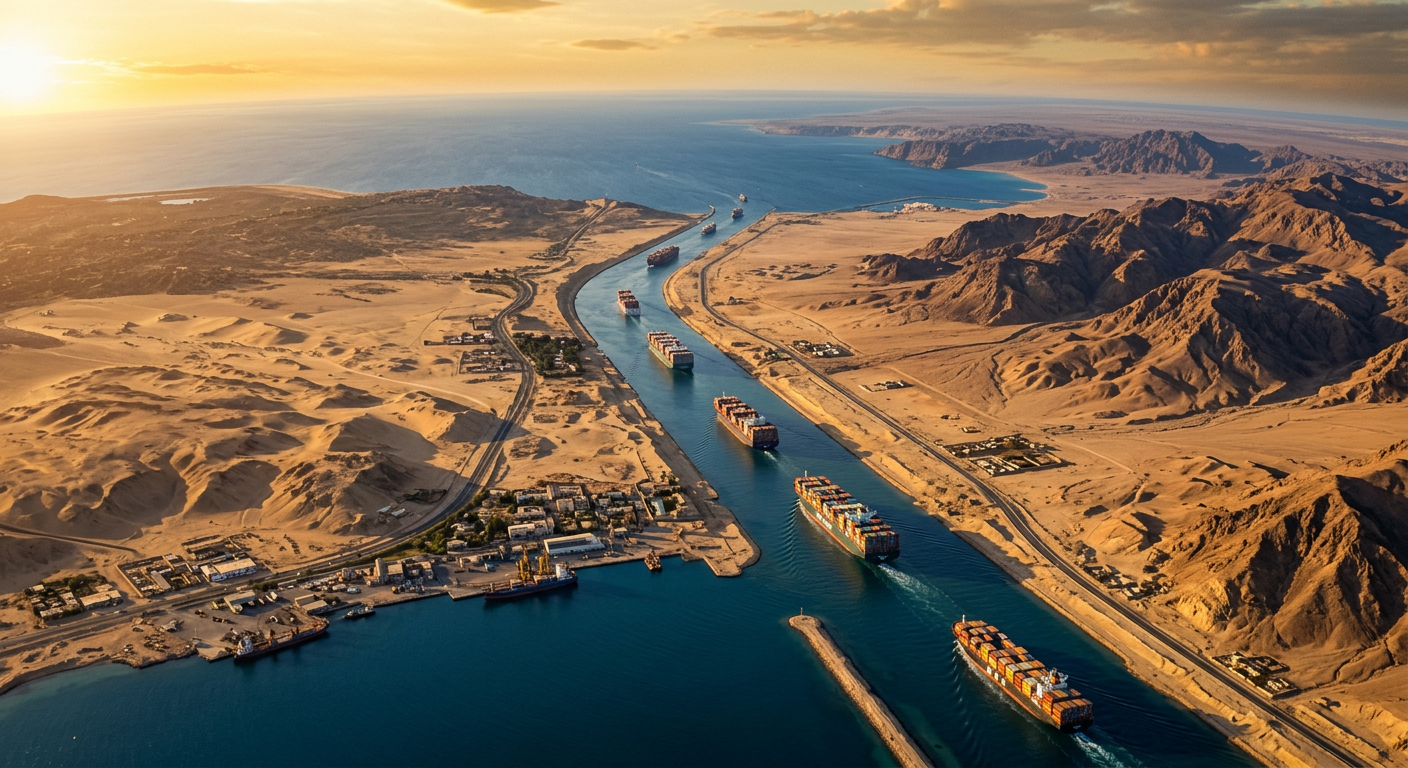
What Happened
At approximately 7:40 a.m. local time on March 23, 2021, the container ship Ever Given entered the southern section of the Suez Canal heading northbound from the Red Sea toward the Mediterranean. The vessel was loaded with roughly 18,300 containers and had a draft of about 16 meters, close to the canal's maximum permitted depth. Winds were high that morning -- sustained at 40 knots with gusts exceeding 50 knots -- kicking up a sandstorm that reduced visibility across the canal zone.
Within minutes of entering the single-lane southern section, the ship lost its ability to steer. Investigators would later attribute the grounding to a combination of strong crosswinds, a possible bank-suction effect from the narrow canal walls, and the vessel's enormous windage area -- the flat, stacked wall of containers acted as a sail tens of meters tall. The ship's bow swung to starboard and struck the eastern embankment. Its stern drifted into the western bank. The Ever Given, 400 meters long and 59 meters wide, was now wedged diagonally across a channel that measured roughly 205 meters wide at that point.
The Suez Canal was completely blocked. No vessel could pass in either direction. Within hours, a queue began forming at both ends of the canal. Within a day, the queue stretched into the Red Sea and the Mediterranean. The most important artificial waterway on Earth was shut.
The Ship
The Ever Given is a Golden-class container ship, one of the largest in the world. It was built in 2018 by Imabari Shipbuilding in Japan and is owned by Shoei Kisen Kaisha, a Japanese leasing company. At the time of the grounding, it was operated by Evergreen Marine Corporation, a Taiwanese shipping line, and flagged in Panama -- a common arrangement in commercial shipping, where ownership, operation, flag state, and crewing are frequently spread across multiple countries.
The numbers tell the story of modern container shipping's relentless drive toward scale. The Ever Given has a nominal capacity of 20,124 TEU (twenty-foot equivalent units), making it one of the largest container ships afloat. It measures 400 meters in length -- longer than the Empire State Building is tall, longer than four football fields laid end to end. Its beam of 59 meters gives it a cross-sectional profile roughly the size of a large apartment building. Fully loaded, it displaces over 220,000 tonnes and sits 16 meters deep in the water. Above the waterline, the stacked containers rise more than 65 meters above the keel, presenting an enormous surface area to wind.
These dimensions matter for understanding what went wrong. The Suez Canal was designed and expanded to handle vessels of this size, but barely. The canal's navigable width in the southern single-lane section left limited margin on either side of the Ever Given's hull. At 59 meters wide in a 205-meter channel, the ship occupied roughly 29% of the canal's width. Under normal conditions, this was sufficient clearance. Under 50-knot crosswinds, it was not.
How a Ship Gets Stuck Sideways
The physics of a large container vessel in a narrow canal are unforgiving. Three forces combined to push the Ever Given out of alignment.
First, wind. A fully loaded container ship presents a massive flat surface to crosswinds. The stacked containers act as an unintentional sail. At the Ever Given's dimensions, the windage area -- the total surface exposed to wind above the waterline -- was estimated at roughly 10,000 square meters. In a 50-knot crosswind, the aerodynamic force on that surface was enough to overpower the ship's rudder, particularly at the low transit speeds required in the canal (typically 7-8 knots).
Second, bank effect. In confined waterways, the flow of water between a ship's hull and the nearby canal wall creates a hydrodynamic asymmetry. When a vessel drifts closer to one bank, the water between hull and wall accelerates, lowering pressure on that side and drawing the ship toward the wall. This effect, well documented in maritime hydrodynamics, grows more pronounced as the ratio of ship beam to channel width increases. For the Ever Given, the margins were thin enough that bank effect became a significant factor.
Third, loss of steerage at low speed. A ship's rudder depends on water flow over its surface to generate steering force. At canal transit speeds, that flow is minimal. When the Ever Given's bow began swinging, the captain had limited ability to correct it. By the time the bow struck the east bank, the ship's momentum and the canal's geometry made recovery impossible. The stern swung into the opposite bank, and the vessel was fixed in place like a cork wedged in a bottle.
The bow embedded itself into the canal's sandy embankment with enormous force. Subsequent surveys found the bow had driven roughly 15 meters into the bank. The vessel's weight -- over 220,000 tonnes fully laden -- settled onto the canal floor, with the bow and stern aground on opposite banks. Simply pulling it free would not work. The suction force of the embedded bow alone was estimated at tens of thousands of tonnes.
Day by Day: The Blockage
The Traffic Jam
By the time the Ever Given was freed, 422 vessels were waiting to transit the canal. They were anchored in the Mediterranean approaches near Port Said, in the Red Sea near Suez, and in the Great Bitter Lake within the canal itself. The queue included container ships, bulk carriers, tankers, LNG carriers, car carriers, and military vessels. Together they carried cargo worth billions of dollars.
The SCA cleared the backlog at a rate of roughly 80 vessels per day, operating around the clock with an expanded convoy schedule. The last of the queued ships transited on April 3, a full eleven days after the grounding. But the backlog did not end at the canal. Ports from Rotterdam to Singapore experienced arrival bunching for weeks afterward as vessels that had been delayed arrived in clusters, overwhelming berth capacity and extending container dwell times.
Some carriers chose not to wait. Approximately 60 to 80 vessels diverted around the Cape of Good Hope during the blockage, accepting the additional 3,000 to 6,000 nautical miles and 7 to 14 extra days of transit. The rerouting cost each vessel an estimated $300,000 to $800,000 in additional fuel alone, depending on size and speed. That does not account for the time value of delayed cargo, the knock-on scheduling disruptions, or the ripple effects on port labor and logistics networks.
Economic Impact
Lloyd's List, the maritime industry's paper of record, estimated that the blockage held up approximately $9.6 billion worth of cargo per day. That figure, widely cited in the aftermath, was calculated based on the average daily value of goods transiting the Suez Canal in 2020 and 2021 -- roughly $5.1 billion westbound (primarily manufactured goods from Asia to Europe) and $4.5 billion eastbound (primarily raw materials, oil products, and automotive components).
Over six days, that amounts to roughly $57 billion in delayed trade. But "delayed" is the operative word. The goods were not destroyed. They were late. The economic damage was not the value of the cargo itself but the cascading cost of lateness: stockout penalties, production line stoppages, spoilage of perishable goods, demurrage charges for vessels waiting at anchor, and the cost of emergency air freight for time-critical shipments.
What Got Stuck
The commodities delayed by the blockage revealed just how broad the Suez Canal's role is in global trade. The canal is not merely an oil route. It is the primary corridor for manufactured goods moving between Asia and Europe, and for raw materials moving in the opposite direction.
Containerized goods made up the largest share of delayed value. Electronics, clothing, automotive parts, machinery, consumer goods -- all the products of Asian manufacturing bound for European markets. The blockage hit during the early stages of the post-COVID demand surge, when retailers and manufacturers were already struggling with supply chain disruptions from the pandemic. Adding a week of delay to an already strained system compounded the pressure on inventories across Europe.
Energy products were the second major category. The canal handles roughly 5-6 million barrels of crude oil per day, plus refined petroleum products and liquefied natural gas. With tankers unable to transit, oil markets tightened immediately. Brent crude rose from approximately $62 per barrel on March 23 to about $65 by March 25. The spike was contained because traders understood the blockage was temporary and physical supply was being stored, not lost. Had the blockage lasted two or three weeks, the price response would have been significantly more severe.
Agricultural products were also affected. Grain shipments from the Black Sea region to Asia, livestock feed, and food imports for the Middle East all transited the canal. Several livestock carriers were stuck in the queue, raising animal welfare concerns as feed and water supplies ran low.
The Insurance Question
The Ever Given incident triggered one of the most complex marine insurance claims in history. The vessel's hull and machinery were insured in the Japanese market. Its protection and indemnity (P&I) coverage -- which covers third-party liabilities including pollution, wreck removal, and damage to infrastructure -- was provided by the UK P&I Club, one of the thirteen member clubs of the International Group of P&I Clubs.
The Suez Canal Authority initially demanded $916 million in compensation from the ship's owners, covering canal repair costs, lost revenue, and salvage expenses. After months of negotiation while the ship was detained in the Great Bitter Lake (Egypt refused to let it leave until a settlement was reached), the parties agreed on a reported figure of approximately $550 million in July 2021. The Ever Given was released and resumed commercial service.
Separately, cargo owners filed claims for delay-related losses. Hundreds of shippers had goods aboard the Ever Given itself or on other vessels trapped in the queue. Marine cargo insurance policies vary in their treatment of delay -- many policies exclude pure delay claims, covering only physical damage or loss. The resulting legal disputes played out across multiple jurisdictions and took years to resolve fully.
For the insurance industry, the broader lesson was the scale of accumulated exposure in a single chokepoint. At any given moment, billions of dollars in insured cargo is transiting the Suez Canal. A longer blockage -- or a deliberate attack rather than an accident -- would generate losses orders of magnitude larger than the Ever Given claim. The incident prompted reinsurers to reconsider their aggregate exposure modeling for chokepoint risk, a reassessment that proved prescient when the Houthi attacks disrupted the same waterway three years later.
Container Rates: Before, During, and After
The blockage hit at a specific moment in the freight rate cycle, and its market impact cannot be separated from that context. In March 2021, container rates were already rising sharply due to pandemic-driven demand, port congestion in the United States, and a severe shortage of empty containers in Asia. The Shanghai Containerized Freight Index (SCFI) composite had roughly tripled from its pre-pandemic baseline.
The blockage added fuel to an already burning fire. Asia-to-Europe spot rates jumped 47% within a week of the grounding, according to the Drewry World Container Index. Asia-to-Mediterranean rates saw an even larger spike. The increases reflected not just the immediate delay but the cascading scheduling disruptions that followed: vessels arriving late at European ports, berth congestion, container equipment imbalances, and blank sailings as carriers scrambled to rebuild their rotations.
After the canal reopened, rates on the Asia-Europe trade did not return to pre-blockage levels. The backlog clearance took weeks, and the underlying market conditions -- strong demand, limited vessel supply, port congestion -- kept rates elevated throughout 2021 and into 2022. It is difficult to disentangle how much of the subsequent rate environment was caused by the Ever Given versus the broader pandemic supply chain crisis, but the blockage unquestionably accelerated rate increases that were already underway.
The Lasting Impact on Supply Chain Risk
The Ever Given did something that decades of academic papers and industry conferences had failed to do: it made chokepoint risk visible to the general public. Satellite images of the wedged ship were shared millions of times. News coverage reached audiences that had never heard of the Suez Canal. "Supply chain" entered everyday vocabulary in a way it never had before.
For the shipping and logistics industry, the incident forced a reckoning with concentration risk. Several developments followed directly from the blockage:
- Canal widening. The Suez Canal Authority announced a $2 billion plan to widen and deepen the southern section where the grounding occurred. The project aims to reduce the probability of a similar obstruction by creating passing zones in sections that were previously single-lane.
- Vessel size debate. The incident intensified an existing debate about whether container ships have become too large. The Ever Given was not even the biggest ship afloat -- vessels exceeding 24,000 TEU were already in service. Critics argued that the canal infrastructure and port systems were not keeping pace with ship sizes. Ship designers countered that larger vessels are more fuel-efficient per container moved, and that the economics of scale are not optional in a competitive market.
- Insurance repricing. Marine insurers began pricing canal transit risk differently, incorporating scenario modeling for extended blockages. Premiums for Suez transit coverage increased modestly after the Ever Given and then dramatically after the Houthi attacks began in late 2023.
- Inventory strategies. Some multinational companies, particularly in automotive and electronics manufacturing, increased their buffer stock levels and diversified their supplier base to reduce exposure to single-chokepoint disruption. Whether this shift will prove durable or revert to just-in-time minimalism under competitive cost pressure remains an open question.
- Alternative route analysis. The blockage renewed interest in the Arctic Northern Sea Route, the land-based China-Europe rail corridors, and pipeline alternatives for energy transport. None of these alternatives is a substitute for the Suez Canal at scale, but the incident prompted serious cost-benefit analysis that had previously been theoretical.
What the Ever Given Taught Us
The blockage lasted six days. The consumer price impact was measurable but modest. No one died. No cargo was lost. In the catalog of maritime disasters, the Ever Given grounding was, objectively, a minor event. Its significance lies not in the damage it caused but in the fragility it revealed.
Consider what the incident demonstrated. A single ship, operated competently under conditions that are not unusual in the Suez Canal region, was pushed sideways by wind. That single event blocked 12% of global trade for nearly a week. The canal had no redundancy -- no second lane in the southern section, no bypass channel, no way to move the ship quickly. The salvage operation required six days of dredging, 14 tugboats, and favorable tidal conditions to resolve. If the bow had been embedded deeper, or if the ship had suffered structural damage, the blockage could have lasted weeks.
Now extrapolate. The Suez Canal handles roughly $1 trillion in annual cargo value. The Strait of Hormuz handles 20% of the world's oil. The Strait of Malacca funnels a quarter of global maritime trade through a channel narrower than many rivers. These chokepoints are single points of failure in a system that has no designed redundancy. They work because ships keep moving through them without incident, day after day, year after year. When one stops working -- through accident, weather, military action, or political decision -- the consequences propagate at the speed of financial markets and arrive at consumer cash registers within weeks.
The Ever Given was a six-day warning. The question it left behind was not whether a chokepoint would be disrupted again, but when, and for how long, and whether it would be an accident or a deliberate act. The Houthi attacks on Red Sea shipping that began in November 2023 answered part of that question. The 2026 Hormuz crisis is answering the rest.
Key Takeaways
- 1. Single points of failure are real. The Suez Canal had no bypass in its southern section. One ship, one bad day, one complete blockage. Global trade infrastructure is built around chokepoints that have no redundancy.
- 2. Ship size amplifies risk. The Ever Given's 400-meter length and 59-meter beam left minimal clearance in the canal. The same economics that make ultra-large ships efficient make them dangerous in confined waterways.
- 3. Economic impact scales with duration. Six days produced a manageable disruption. Two weeks would have been far worse. A month would have reshaped supply chains. The severity of a chokepoint closure is not linear -- it compounds.
- 4. Insurance is the canary. Marine insurance markets repriced Suez risk within days of the grounding and dramatically again after the Houthi attacks. Insurance premiums are among the earliest and most reliable signals of chokepoint vulnerability.
- 5. Accidents are dress rehearsals for deliberate disruption. The Ever Given was an accident that lasted six days. The Houthi attacks are a deliberate campaign that has lasted years. The same waterway, the same vulnerability, but with profoundly different duration and economic consequences.