A Canal That Runs on Rain
The Panama Canal is not, as many people assume, a sea-level trench cut through the isthmus. It is a freshwater lock system built on top of a man-made lake, and that distinction explains everything about its vulnerability to drought.
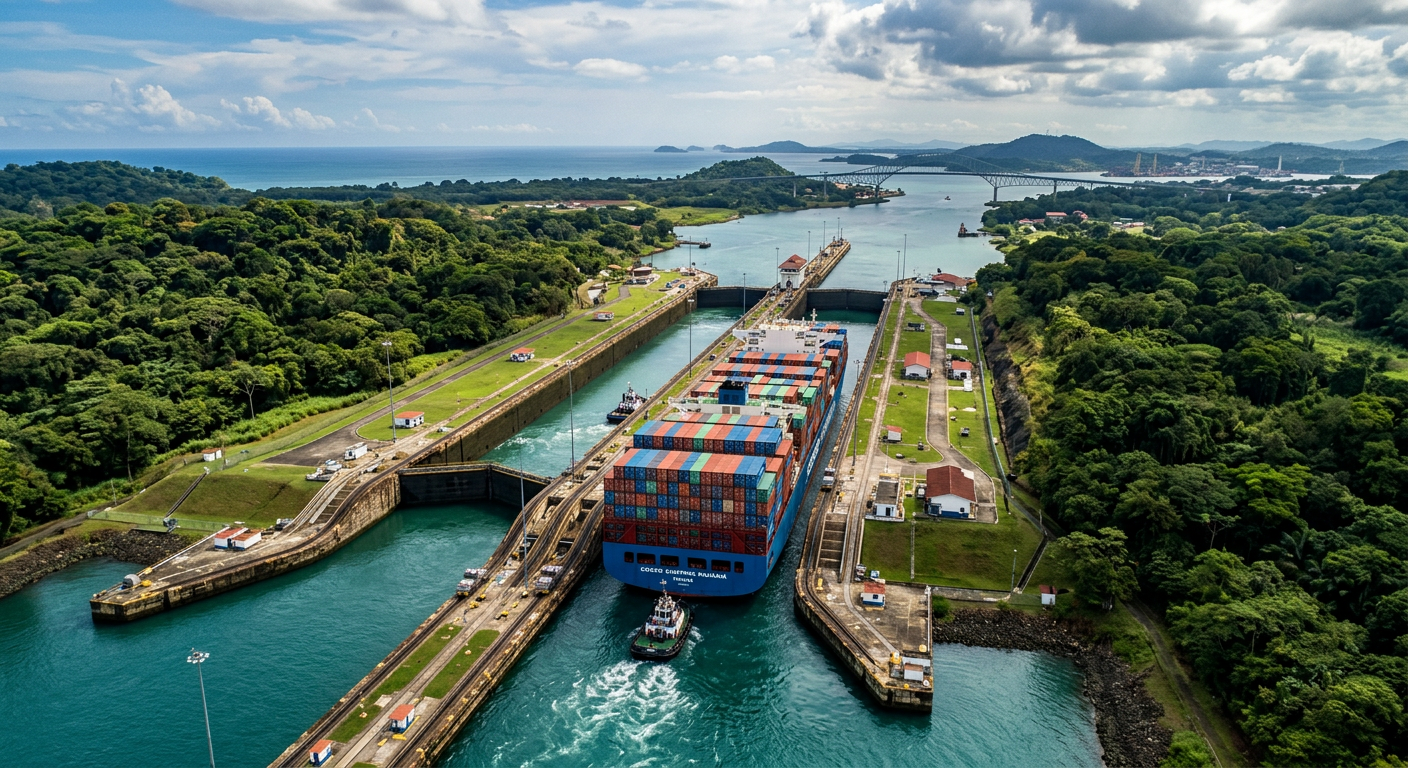
When the canal opened in 1914, American engineers had solved what the French could not: rather than digging to sea level through 50 miles of jungle, rock, and unstable clay, they dammed the Chagres River to create Gatun Lake, an artificial body of water sitting 85 feet above sea level. Ships entering from the Atlantic side are raised through three sets of locks (the Gatun Locks) to the level of the lake, sail across it, and are then lowered through another set of locks (the Pedro Miguel and Miraflores Locks) to the Pacific. The entire transit takes eight to ten hours.
The system is elegant, but it has a fundamental dependency: every single transit consumes water. Each time a ship passes through a lock chamber, approximately 52 million gallons of fresh water flow by gravity from Gatun Lake into the ocean. That water is not recycled. It is gone. In a normal year, the Panama Canal uses roughly 2 billion gallons of fresh water per day just for lockages. The water is replenished by rainfall in the canal's watershed, a 1,290-square-mile catchment area of tropical forest that channels runoff into the Chagres River and its tributaries, which feed Gatun Lake and the smaller Alajuela Lake (the canal's reserve reservoir).
When rainfall is normal, the system is self-sustaining. Gatun Lake stays at or near its optimal operating level of about 87.5 feet above sea level, and the canal can handle 36 to 38 vessel transits per day. When rainfall drops, the lake drops, and the Panama Canal Authority (ACP) faces a choice that no amount of engineering can avoid: reduce transits, restrict the draft (depth) of vessels allowed through, or both.
How Water Levels Determine Capacity
The relationship between Gatun Lake's water level and the canal's throughput is not linear. It is a step function with hard thresholds.
At 87.5 feet, the canal operates at full capacity. Vessels with drafts up to 50 feet (the maximum the Panamax locks can accommodate) can transit, and the ACP schedules 36 to 38 transits per day across the original Panamax locks and the newer Neopanamax locks.
At 85 feet, the ACP begins imposing draft restrictions. Ships drawing more than 44 feet of water must either lighten their cargo (reducing the amount they carry per transit) or wait for conditions to improve. Draft restrictions do not reduce the number of transits, but they reduce the cargo per transit, which means more ship-days are required to move the same volume of goods.
At 82 feet, restrictions tighten further. The ACP reduces the number of daily transits to conserve water, typically from 36 to 32 and then lower. Waiting times for non-priority vessels stretch from hours to days, and then to weeks.
Below 80 feet, the canal enters crisis mode. At these levels, the Neopanamax locks (which are wider and deeper and consume more water per lockage) face the steepest restrictions. The ACP may cut transits to 24 or fewer per day. Vessels queue at anchor on both sides of the canal, sometimes for three weeks or more. Auction prices for priority transit slots, which normally run a few hundred thousand dollars, can exceed $4 million per passage.
The 2016 Neopanamax locks, which were designed to handle the larger Post-Panamax vessels that dominate modern container and LNG shipping, use water-saving basins that recycle about 60% of the water from each lockage. But 60% recapture still means 40% loss, and the Neopanamax chambers are larger, so each lockage still draws heavily on the lake. The expansion increased the canal's capacity in vessel size and throughput, but it also increased its total water consumption.
The 2023-24 Drought Crisis
In the second half of 2023, the Panama Canal experienced the worst drought in its 110-year operating history. Rainfall in the canal watershed dropped to levels not seen since record-keeping began in the early twentieth century, driven by an unusually strong El Nino event that suppressed precipitation across Central America.
By October 2023, Gatun Lake had fallen to 79.9 feet, more than seven feet below its optimal operating level. The ACP responded with escalating restrictions that progressively strangled the canal's throughput:
Timeline: The 2023-24 Canal Restrictions
At the worst point, the canal was operating at roughly 60% of its normal throughput. This was not a closure. The canal remained open every day of the crisis. But reduced capacity in a system that handles 5% of global seaborne trade has consequences that ripple far beyond the isthmus.
Draft Restrictions and Cargo Economics
Draft restrictions are a blunt instrument with sharp economic teeth. A container ship's draft, the depth of its hull below the waterline, increases as it loads more cargo. When the ACP restricts maximum draft from 50 feet to 44 feet, it does not tell ships they cannot transit. It tells them they cannot transit fully loaded.
For a Neopanamax container vessel, a six-foot draft reduction can mean leaving 3,000 to 4,000 TEUs (twenty-foot equivalent units) behind. For an LNG carrier, it can mean reducing cargo volume by 15-20%, which alters the economics of the entire voyage. The ship still pays the canal toll (which is based on vessel size, not cargo volume), still burns fuel, and still ties up a crew for the transit. But it earns revenue on fewer containers or fewer cubic meters of gas. The cost per unit of cargo carried rises accordingly, and that cost lands on the shipper and, eventually, on the consumer.
Some carriers chose to "top off" their vessels by offloading cargo to a second ship on one side of the canal and reloading on the other side. This workaround preserves cargo volume but doubles the port handling cost and adds two to three days to the schedule. Other carriers simply routed around the canal entirely.
Impact on Container Shipping and LNG
The Panama Canal handles two categories of traffic that matter most for consumer prices: container ships running between Asia and the U.S. East Coast, and LNG carriers connecting Gulf Coast export terminals with Asian buyers.
For container shipping, the canal is the primary route for goods moving from East Asia to eastern U.S. ports like New York, Savannah, and Houston. When canal capacity dropped, container lines faced a stark choice: pay elevated tolls and accept smaller loads through Panama, or reroute through the Suez Canal (adding 5-8 days and significant fuel cost), or go around the southern tip of South America via the Strait of Magellan and Drake Passage (adding 14-20 days and enormous fuel cost).
Most large container lines rerouted their largest vessels through Suez. Maersk, MSC, CMA CGM, and Hapag-Lloyd all shifted capacity away from the Panama route during the worst months of the crisis. The effect was to increase Suez congestion (which was already elevated due to the Red Sea crisis that began in November 2023) and to raise freight rates on Asia-to-U.S. East Coast lanes by 30-60% during the fourth quarter of 2023.
For LNG, the impact was more concentrated. The United States became the world's largest LNG exporter in 2023, and a significant share of U.S. Gulf Coast LNG exports transit the Panama Canal en route to Asian buyers in Japan, South Korea, and China. LNG carriers are purpose-built vessels that cannot easily shed cargo the way a container ship can unload boxes. An LNG carrier transiting at reduced draft carries less gas, and there is no option to "top off" liquefied natural gas at a roadside terminal.
During the restrictions, spot LNG shipping rates on the Gulf-to-Asia route rose sharply. Some cargoes were rerouted through Suez, adding cost and time. A few sellers diverted cargoes to closer European buyers, where the journey through Suez is shorter. The net effect was a temporary reshuffling of global LNG trade flows, with Asian spot prices for gas rising 15-25% above where they would have been without the canal disruption.
The El Nino Connection
The 2023-24 drought was not random. It was driven by El Nino, the periodic warming of Pacific Ocean surface temperatures that suppresses rainfall across Central America, northern South America, and parts of Southeast Asia. El Nino events vary in strength and duration, but strong events reliably reduce precipitation in the Panama Canal watershed.
The historical record shows the pattern clearly. The canal experienced notable low-water periods during the El Nino events of 1982-83, 1997-98, and 2015-16. The 2023-24 event was the strongest since 1997-98 and produced the lowest recorded Gatun Lake levels since the canal opened. The ACP has acknowledged that it did not adequately model the tail risk of a strong El Nino occurring after several years of below-trend rainfall, which had already drawn down reservoir levels before the drought accelerated.
El Nino follows a roughly irregular cycle of two to seven years. Its counterpart, La Nina, tends to bring above-average rainfall to Central America, replenishing the watershed. The problem for long-term planning is that climate models suggest El Nino events may become more frequent and more intense as ocean temperatures rise, while La Nina events may become shorter and less effective at restoring water levels. If that projection holds, the canal's baseline water availability will decline decade by decade, even without any single catastrophic drought.
Long-Term Climate Projections
The ACP commissioned a comprehensive climate study in 2023 that produced results the authority described as "sobering." The study, conducted with the Smithsonian Tropical Research Institute and several international climate modeling groups, projected three scenarios for the canal watershed through 2050:
| Scenario | Rainfall Change | Drought Frequency | Capacity Impact |
|---|---|---|---|
| Moderate warming | -5 to -10% by 2050 | 2023-level drought every 8-12 years | Periodic restrictions, manageable with new water sources |
| High warming | -10 to -20% by 2050 | 2023-level drought every 4-6 years | Chronic restrictions; permanent 20-30% capacity reduction likely |
| Severe warming | -20% or worse by 2050 | Near-permanent low-water conditions | Canal requires fundamental redesign or supplemental water supply at massive cost |
The ACP has responded with a $2 billion investment plan to secure the canal's water supply. The centerpiece is a proposal to build a new reservoir on the Rio Indio, west of the existing watershed, and connect it to Gatun Lake via pipeline. The project would add an estimated 750 million gallons per day of fresh water capacity, enough to sustain full canal operations even during moderate droughts. But the project faces environmental opposition from communities in the Rio Indio valley, indigenous land rights concerns, and a construction timeline of eight to ten years. Even if approved and funded tomorrow, the new reservoir would not be operational before 2034.
In the interim, the ACP is experimenting with cross-filling between lock chambers (using water from one chamber to fill an adjacent one, reducing net consumption by about 15%) and a freshwater recycling system for the original Panamax locks. These measures are incremental. They buy time, but they do not solve the structural water deficit that climate models project.
Alternative Routes
When the Panama Canal restricts capacity, shippers face three alternatives, none of them good.
The Suez Canal is the most common reroute. For Asia-to-U.S. East Coast traffic, routing through Suez, the Mediterranean, and across the Atlantic adds approximately 5 to 8 days compared to the Panama route, depending on the vessel's speed and the specific port pair. The Suez route also carries its own risks: since November 2023, Houthi attacks on commercial shipping in the Red Sea have made the southern approach to Suez dangerous, forcing many vessels to detour around the Cape of Good Hope, which adds another 10-14 days. The combined reroute (avoiding both Panama and the Red Sea) can add three weeks or more to a transpacific journey that normally takes 20-25 days.
Cape Horn and the Strait of Magellan form the southernmost alternative. Rounding the southern tip of South America adds 14 to 20 days to a transpacific voyage, depending on weather conditions. The Drake Passage, between Cape Horn and Antarctica, is one of the most dangerous stretches of open water in the world. Swells regularly exceed 30 feet. Modern container ships and tankers can handle the conditions, but the fuel cost is steep (an extra $500,000 to $1 million per voyage for a large container ship), and the scheduling unpredictability is difficult for just-in-time supply chains to absorb.
The Northwest Passage through the Canadian Arctic is sometimes mentioned as a future alternative, and in fact, seasonal melting has made the passage navigable for brief windows in recent summers. But the Northwest Passage is not commercially viable for regular shipping. Its navigation season is limited to roughly six to eight weeks per year. The route requires ice-class vessels. Canada's sovereignty claims over the passage are disputed. Port and rescue infrastructure along the route is minimal. And even in the best ice conditions, the route adds time for most Asia-to-East Coast journeys compared to an unrestricted Panama Canal. The Northwest Passage is a climate curiosity, not a shipping solution.
The 2016 Expansion and Its Paradox
In 2016, the Panama Canal completed its largest expansion since the original construction: a third set of locks, the Neopanamax locks, built to accommodate vessels far larger than the original Panamax specification could handle. The original locks accept ships up to 965 feet long and 106 feet wide. The Neopanamax locks accept ships up to 1,200 feet long and 168 feet wide, large enough for the 13,000-TEU to 14,000-TEU container ships that form the backbone of modern transpacific trade, and for the Q-Flex and Q-Max LNG carriers that transport Qatari and American gas to Asian markets.
The expansion was a commercial success. It allowed the canal to compete for traffic that had previously been too large to transit, and it increased the canal's annual revenue from about $2.4 billion in 2016 to over $4.3 billion in 2023. But the expansion also deepened the canal's water problem.
Although the Neopanamax locks incorporate water-saving basins that recapture roughly 60% of the water used in each lockage, the chambers themselves are far larger than the original locks, so the absolute volume of water consumed per transit is higher. The expansion increased the canal's maximum throughput from about 35 vessels per day to 38-40, but it also increased the canal's maximum daily water consumption. In a year of normal rainfall, this is manageable. In a drought year, the expanded canal drains Gatun Lake faster than the original canal would have.
This is the paradox: the expansion made the canal more capable and more profitable in good times, but more fragile in bad times. The same infrastructure that enabled the canal to capture LNG and ultra-large container traffic also amplified its exposure to the one input it cannot control: rainfall.
Economic Impact: Panama and the World
The Panama Canal is not just a shipping lane. It is the fiscal foundation of the Panamanian state. In fiscal year 2023, the canal contributed $2.5 billion directly to the Panamanian government treasury, roughly 6% of the country's GDP. The canal and its associated logistics sector (port operations, free trade zones, shipping services, banking, insurance) account for approximately 25-30% of Panama's total economic activity. There is no country on Earth more dependent on a single piece of infrastructure.
The 2023-24 drought reduced canal revenues by an estimated $700 million to $800 million over the affected period. This was partly offset by the auction system for priority transit slots, which generated substantial premium revenue (one container ship operator paid $3.97 million for a single priority transit in November 2023). But the auction revenue came at the cost of goodwill and long-term customer relationships. Shippers who paid millions for a single transit in 2023 began diversifying their route planning and building permanent alternatives into their logistics networks.
For global trade, the canal's disruption compounded the simultaneous Red Sea crisis. By January 2024, two of the world's five critical chokepoints, Panama and Bab-el-Mandeb, were operating at reduced capacity for entirely different reasons: drought and armed conflict. The simultaneous disruption was unprecedented in the modern era of containerized shipping. It forced global container rates up by 40-80% on key trade lanes during the first quarter of 2024 and added an estimated 0.2 to 0.4 percentage points to U.S. consumer price inflation over the following six months, according to analysis by the Federal Reserve Bank of New York.
The compounding effect is the critical insight. The global shipping network has limited redundancy. When one chokepoint fails, traffic reroutes through others. When two fail at the same time, the network has few remaining options, and the cost of moving goods rises for everyone, not just for shippers directly affected by either disruption.
What to Watch
The Panama Canal's water crisis is structural, not episodic. The 2023-24 drought will not be the last, and the ACP's long-term water projects will take a decade to deliver. These are the indicators that matter for tracking the canal's capacity and its effect on shipping costs:
- Gatun Lake water level. The ACP publishes daily readings. Levels above 85 feet support full operations. Below 82 feet, restrictions are likely. Below 80 feet, expect significant transit cuts.
- ACP daily transit numbers. The canal authority publishes the number of scheduled transits per day. Normal is 36-38. Anything below 30 indicates meaningful constraints.
- Draft restriction announcements. The ACP announces maximum allowable draft in advance. Restrictions below 44 feet (Tropical Fresh Water) signal serious conditions.
- Booking slot auction prices. Premium transit slots are auctioned when demand exceeds capacity. Auction prices above $1 million indicate severe congestion; above $3 million indicates crisis.
- ENSO forecasts. NOAA's Climate Prediction Center publishes El Nino/La Nina outlooks monthly. An El Nino forecast for the coming dry season (typically January to April in Panama) raises the probability of drought-related restrictions.
- Container line route announcements. When Maersk, MSC, or CMA CGM announce service reroutings away from Panama, the market is pricing in sustained disruption.
Key Takeaways
- 1. The canal runs on rain. Every transit consumes 52 million gallons of fresh water from Gatun Lake. No rain, no transits. This is not an engineering limitation that can be fixed with better locks; it is a fundamental dependency on the hydrological cycle.
- 2. Draft restrictions are the hidden tax. Cutting maximum draft from 50 to 44 feet does not close the canal, but it forces ships to carry less cargo per transit, raising the effective cost per container or per barrel by 15-25%.
- 3. The 2016 expansion increased both capacity and fragility. Neopanamax locks enabled larger ships and LNG transits, but they also increased total water consumption, making the canal more sensitive to drought.
- 4. El Nino is the trigger, climate change is the trend. The 2023-24 drought was driven by El Nino, but long-term projections show declining baseline rainfall in the canal watershed. Droughts will become more frequent and more severe.
- 5. Simultaneous chokepoint failures compound costs. When Panama and the Red Sea were disrupted at the same time, global freight rates surged because the network ran out of alternative routes. The canal does not exist in isolation; its disruption compounds with every other chokepoint problem.
- 6. Alternatives are expensive and slow. Cape Horn adds three weeks. Suez adds one week and carries its own risks. The Northwest Passage is not commercially viable. There is no free detour around a constrained Panama Canal.