The Geography of a Bottleneck
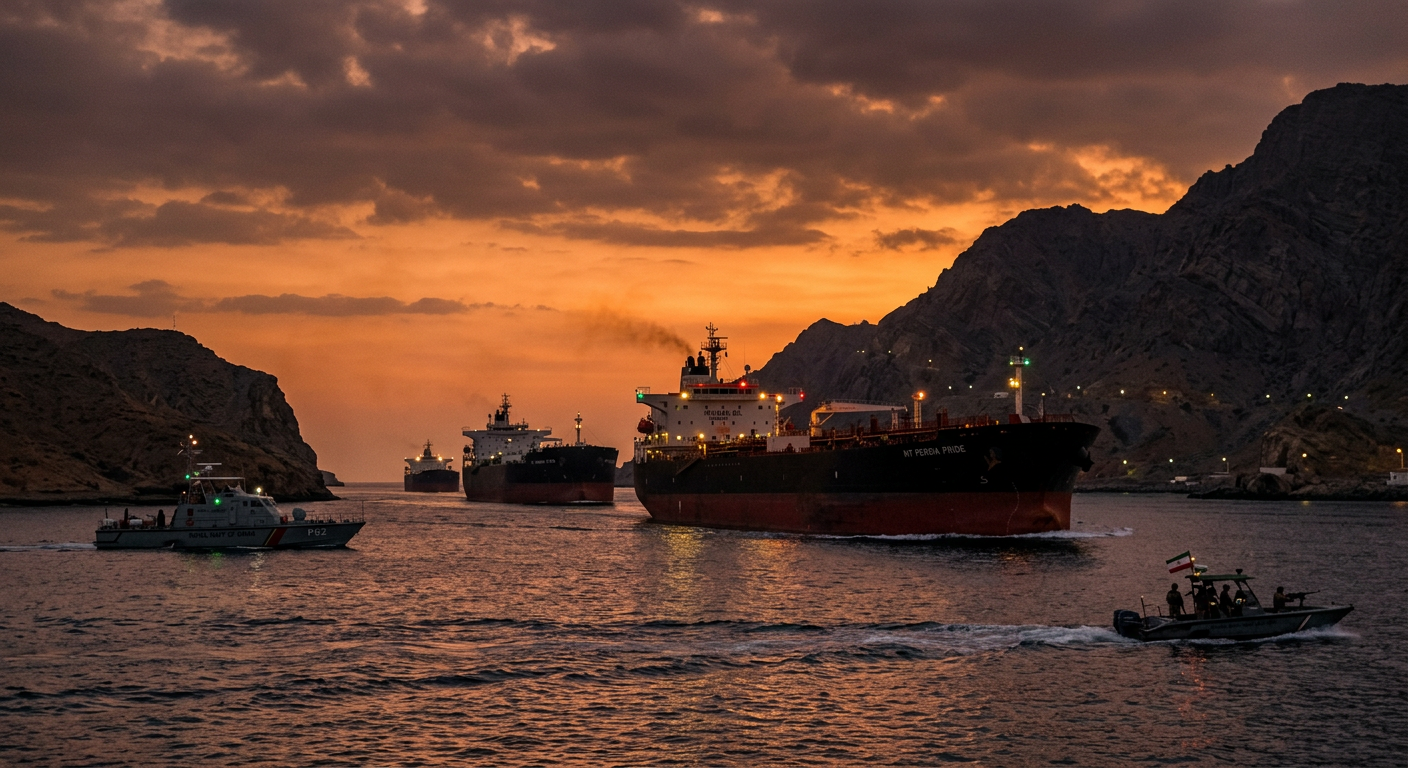
The Strait of Hormuz is a narrow waterway connecting the Persian Gulf to the Gulf of Oman and, beyond it, the open Indian Ocean. At its narrowest point, the strait measures roughly 21 nautical miles from the Iranian coast to the tip of the Musandam Peninsula, a rocky finger of Omani territory that juts north into the shipping lanes. Those 21 miles are, by any serious measure, the most economically important body of water on Earth.
But the navigable channel is far tighter than the strait itself. The internationally recognized Traffic Separation Scheme, managed under the International Maritime Organization, divides the strait into two shipping lanes, each roughly two miles wide, separated by a two-mile-wide median buffer zone. Inbound traffic (entering the Persian Gulf) uses the northern lane, closer to Iran. Outbound traffic (leaving the Gulf, carrying oil) uses the southern lane, closer to Oman. Vessels making the transit are squeezed into corridors roughly the width of a four-lane highway, within easy visual range of the Iranian coast and well within range of Iranian shore-based anti-ship missiles, fast-attack craft, and naval mines.
This geography is the foundation of everything that follows. Iran does not need to "close" the Strait of Hormuz in any absolute military sense. It needs only to make transit dangerous enough that commercial insurers refuse to cover tankers, or expensive enough that shipping economics break. A few mines, a few missile strikes, a few seized vessels, and the world's most important oil artery becomes uninsurable. And uninsurable means unshippable.
What Flows Through Hormuz
In a normal year, approximately 20.5 million barrels of crude oil and condensate transit the Strait of Hormuz every day. That figure, drawn from the U.S. Energy Information Administration's most recent assessment, represents roughly 20% of global oil consumption. No other chokepoint comes close. The Suez Canal handles about 5-6 million barrels per day. The Strait of Malacca carries 16 million, but much of that is oil that already transited Hormuz en route to Asia.
The oil comes from five Gulf states that have no meaningful alternative export route:
- Saudi Arabia ships approximately 6.3 million barrels per day through Hormuz, the majority of its total exports. Saudi Aramco operates the East-West Pipeline (Petroline) as a partial alternative, but its capacity is limited and it terminates at Yanbu on the Red Sea, which itself faces Houthi-related shipping risks.
- Iraq exports about 3.3 million barrels per day through its southern terminals at Basrah, all of which transits Hormuz. Iraq's northern pipeline through Turkey has been shut since 2023 due to a legal dispute.
- The UAE ships roughly 2.9 million barrels per day. Abu Dhabi operates the Habshan-Fujairah pipeline, which bypasses Hormuz by routing oil overland to the port of Fujairah on the Gulf of Oman. Its capacity is about 1.5 million barrels per day, covering slightly over half of normal UAE exports.
- Kuwait exports approximately 1.7 million barrels per day, all through Hormuz. Kuwait has no pipeline bypass.
- Qatar ships about 600,000 barrels of crude per day, but its real strategic exposure is natural gas. Qatar is the world's largest exporter of liquefied natural gas, and all of its LNG cargoes pass through Hormuz. That is roughly 25% of the entire global LNG trade.
Add it up: approximately 15 million barrels per day of crude oil exports flow through Hormuz from countries with no complete alternative route. The pipeline bypasses that exist (discussed below) cover perhaps 3.5-4 million barrels at maximum theoretical capacity, and most of that capacity has never been tested under sustained crisis conditions.
A History of Threats, Tested Once
Hormuz has been a flashpoint for decades, but before the spring 2026 episode it had been seriously disrupted only once. Understanding that history matters because it reveals what escalation at Hormuz actually looks like.
The Tanker War (1984-1988)
During the Iran-Iraq War, both belligerents attacked oil tankers in the Persian Gulf. Iraq struck Iranian oil facilities and tankers to choke off Iran's revenue. Iran retaliated by attacking tankers carrying oil from Kuwait and Saudi Arabia, which were financing Iraq's war effort. Between 1984 and 1988, over 400 vessels were attacked. Insurance rates for Gulf transits rose tenfold. The U.S. Navy intervened in 1987 under Operation Earnest Will, reflagging Kuwaiti tankers under the American flag and providing direct naval escort.
The Tanker War established a precedent that still shapes military planning: Iran does not need to close Hormuz to cause economic damage. It needs only to make the waters dangerous enough to spike insurance premiums and deter commercial shipping. In 1987-88, Iranian mine-laying damaged the frigate USS Samuel B. Roberts, and the U.S. responded with Operation Praying Mantis, the largest American naval engagement since World War II. Oil prices spiked but did not reach catastrophic levels because the disruption was partial and both sides had incentives to keep oil flowing.
The 2019 Tanker Attacks
In May and June 2019, six oil tankers were attacked near the Strait of Hormuz with limpet mines. The U.S. attributed the attacks to Iran; Iran denied involvement. In June 2019, Iran's Islamic Revolutionary Guard Corps (IRGC) shot down a U.S. Navy RQ-4 Global Hawk surveillance drone over or near the strait. In July, IRGC naval forces seized the British-flagged tanker Stena Impero in the strait itself.
Oil prices rose modestly after the attacks, but the market impact was surprisingly muted. Brent crude gained about 4-5% on the worst days. The reason: the attacks were isolated, not sustained. Markets can absorb a tanker seizure. Markets cannot absorb a coordinated campaign to deny transit.
Iran's Mine Warfare Capability
Iran maintains the largest inventory of naval mines in the Middle East, estimated at 5,000 to 6,000 mines of various types, from unsophisticated contact mines to advanced influence mines that can be programmed to detonate under specific vessel signatures. The IRGC Navy operates a fleet of small fast-attack craft, many capable of covertly laying mines at night in the shallow waters of the strait. Mine clearance is painstaking work. A single mine, costing perhaps $10,000 to $25,000, can shut down a shipping lane for days while naval minesweepers verify clearance. The economic asymmetry is staggering: the cost to disrupt vastly exceeds the cost to lay the mines.
The Spring 2026 Crisis
The spring 2026 confrontation at the Strait of Hormuz was the most serious disruption to the waterway in its modern history, exceeding the Tanker War in both economic impact and strategic scope. It ran roughly from March into late April 2026, then de-escalated. The strait now flows at close to normal volumes, though tension has not fully cleared. The account below is written in the past tense because the acute phase is over.
How It Started
The crisis emerged from the escalating U.S.-Iran confrontation over Iran's nuclear program. After the collapse of indirect negotiations in late 2025, the United States imposed a new round of "maximum pressure" sanctions targeting Iran's oil exports, including secondary sanctions on Chinese refiners buying Iranian crude. Iran, facing a severe contraction in its primary revenue source, began signaling that it would use its leverage at Hormuz if sanctions tightened further.
In early 2026, IRGC naval forces began conducting aggressive exercises in and around the strait, including live-fire drills within visual range of commercial shipping lanes. In late February, the U.S. Central Command (CENTCOM) announced Operation Epic Fury, deploying additional carrier strike group assets to the Gulf region. The name was a deliberate signal; the operation was designed to deter Iranian action while positioning forces for a response.
Escalation
The situation deteriorated in March 2026. IRGC fast-attack boats began harassing commercial tankers transiting the strait, approaching at high speed and circling vessels in patterns consistent with mine-laying preparation. Several tankers reported near-miss incidents. On March 14, a commercial tanker reported striking what appeared to be a mine in the outbound shipping lane, suffering hull damage but no casualties. The vessel was towed to Fujairah.
Within 48 hours of the confirmed mine strike, Lloyd's of London and the London insurance market added the entire Strait of Hormuz to the Joint War Committee's Listed Areas, designating it as a high-risk zone. War-risk insurance premiums for Hormuz transits surged from roughly 0.05% of hull value to over 2%, and then to 5% or higher for some routes. For a VLCC (Very Large Crude Carrier) valued at $120 million, that translated to a single-transit insurance cost exceeding $6 million, compared to roughly $60,000 under normal conditions.
The insurance market did what mines alone could not: it made transits economically irrational for many shipowners. Tanker traffic through Hormuz dropped sharply. By late March, daily oil flow through the strait had fallen from its normal level of approximately 20 million barrels to an estimated 5-8 million barrels, with the remaining traffic consisting primarily of tankers willing to transit without insurance or with state-backed coverage.
The Military Situation
Through mid-April 2026, the U.S. Navy and coalition partners conducted mine-clearing operations in the strait. The work was slow and contested. Iran never acknowledged laying mines and officially denied any blockade, but IRGC fast-attack craft kept operating in the shipping lanes and additional mines were discovered. The U.S. warned Iran that further mine-laying would be met with direct strikes on IRGC naval facilities. Iran countered that any attack on Iranian territory would result in full closure of the strait. By late April, back-channel de-escalation and completed mine-sweeping allowed insurers to relax the listing, and traffic recovered over the following weeks.
The standoff was not a traditional military blockade. It was something more subtle and harder to counter: a campaign to make the strait uninsurable, and therefore commercially impassable, without firing a shot that would trigger an unambiguous casus belli. That approach exploited the gap between military force and commercial risk tolerance. The strait remains a live geopolitical risk, and the site's chokepoint severity score still reads high at 69.5. But the acute closure risk that defined the spring episode has passed, and the current forecast assumes no sustained Hormuz closure through the third quarter of 2026.
Pipeline Alternatives and Their Limits
Whenever Hormuz is threatened, analysts point to pipeline alternatives. These alternatives exist, but they are far less capable than popular coverage suggests.
| Pipeline | Route | Capacity | Limitations |
|---|---|---|---|
| Petroline (East-West) | Abqaiq, Saudi Arabia to Yanbu, Red Sea | ~5M bbl/day (theoretical) | Operates at ~2M; Yanbu faces Red Sea/Houthi risks; ramp-up takes weeks |
| Habshan-Fujairah | Abu Dhabi to Fujairah, Gulf of Oman | 1.5M bbl/day | Bypasses Hormuz but covers only ~half of UAE exports |
| IPSA (Iraq) | Basrah to Ceyhan, Turkey | ~1.6M bbl/day | Shut since March 2023; legal dispute between Iraq and Turkey; infrastructure degraded |
In the best case, these pipelines could reroute roughly 3.5 to 4 million barrels per day away from Hormuz. That leaves a gap of approximately 11-12 million barrels per day with no alternative route. No pipeline can carry LNG, so Qatar's entire natural gas export capacity remains fully dependent on the strait. The pipelines also cannot ramp to full capacity overnight. The Petroline has not operated at its theoretical maximum in years, and doing so requires coordination across pumping stations and storage facilities along the route.
The Red Sea alternative also carries its own risks. Saudi Arabia's Yanbu terminal sits on the Red Sea, which has been subject to Houthi attacks on commercial shipping since late 2023. Routing oil away from one conflict zone and into another is not a solution; it is a redistribution of risk.
Insurance as a Weapon
The 2026 crisis has demonstrated something that military planners understood but commodity markets had underpriced: maritime insurance is a chokepoint within the chokepoint.
Commercial shipping operates on a layered insurance structure. Hull and machinery insurance covers the physical vessel. Protection and Indemnity (P&I) insurance covers third-party liabilities. Cargo insurance covers the goods. War-risk insurance is an additional layer, required whenever a vessel enters a high-risk area designated by the Joint War Committee (JWC) in London. Without war-risk coverage, most charter parties prohibit transit. Without P&I coverage, most ports refuse entry.
When the JWC listed the Strait of Hormuz, the insurance market effectively imposed a toll on every barrel of oil flowing through the strait. At 5% of hull value per transit, a single VLCC round-trip (entering the Gulf empty, loading, and departing loaded) can cost $10-12 million in war-risk premiums alone. That cost lands directly on the price of crude oil. For a VLCC carrying 2 million barrels, the insurance premium adds $5-6 per barrel before any other cost increase.
Some tanker operators have chosen to transit without insurance, relying on state guarantees or self-insurance. Chinese and Indian national shipping lines have continued some transits under government backing. But the majority of the internationally traded tanker fleet, insured through London and Scandinavian markets, has reduced or halted Hormuz transits. The result is a de facto partial blockade achieved not through military force but through financial risk pricing.
Oil Prices and Gasoline: The Transmission Mechanism
The connection between Hormuz and the price at your local gas station is direct and fast. Crude oil is the single largest input cost in gasoline production, accounting for roughly 55-60% of the retail price. When Brent crude moves, gasoline follows within two to four weeks.
Price Transmission: Hormuz to Your Gas Station
Before the spring 2026 crisis, Brent crude traded in the range of $70-80 per barrel. At the April peak, Brent traded between $110 and $125 per barrel, reflecting both the physical reduction in supply and the risk premium markets assigned to the possibility of further escalation. Some trading desks modeled a full closure scenario (zero flow through Hormuz) at $150-200 per barrel. That scenario never materialized. Prices have since fallen back to roughly $76 as of July 2026, near the pre-crisis range, once transit resumed and the risk premium bled out of the curve.
For American consumers, the arithmetic is roughly this: every $10 increase in the price of a barrel of crude oil translates to approximately $0.25 per gallon at the pump, with a lag of two to four weeks. At its peak the Hormuz disruption added roughly $35-50 per barrel to crude prices, which translated to $0.90-1.25 per gallon in higher gasoline costs. A household driving 1,000 miles per month at 25 miles per gallon was paying an extra $36-50 per month in fuel costs during the worst of the episode. As the spike unwound, that surcharge unwound with it: U.S. regular averaged about $3.78 per gallon in July 2026, down from the spring peak.
But gasoline is only the most visible channel. Diesel fuel powers the trucks, trains, and ships that move goods domestically. Jet fuel costs feed into airfare. Natural gas prices, elevated by the disruption to Qatari LNG flows, affect electricity costs in states that rely on gas-fired power generation and home heating costs for the roughly 47% of American households that use natural gas. The Federal Reserve Bank of Dallas estimated in March 2026 that a sustained 50% reduction in Hormuz oil flow would add 0.8 to 1.2 percentage points to U.S. headline CPI inflation over six months.
Why Hormuz Is the Single Most Important Chokepoint
Other maritime chokepoints matter. The Suez Canal handles 12-15% of global trade. The Panama Canal connects Atlantic and Pacific supply chains. The Strait of Malacca is the primary route for East Asian oil imports. All of them can be disrupted, and all of them have been. But none of them carries the same systemic risk as Hormuz, for three reasons.
First, the commodity that flows through Hormuz has no short-term substitute. Container ships rerouted from the Suez Canal around the Cape of Good Hope add 10-14 days and higher fuel costs, but the goods still arrive. Oil blocked at Hormuz does not arrive, because there is insufficient pipeline capacity to compensate. There is no Cape of Good Hope detour for 15 million barrels of crude oil per day.
Second, the concentration of supply is extreme. Five countries, all located on the Persian Gulf, collectively account for roughly 30% of global oil exports. All five depend on a single 21-mile-wide passage. No other chokepoint funnels this much supply from this many producers through this narrow a corridor.
Third, the speed of price transmission is unmatched. A disruption at Hormuz reaches global oil futures within minutes, wholesale fuel markets within days, and retail gasoline within weeks. By contrast, a container shipping disruption at Suez or Panama takes 30-120 days to transmit into consumer goods prices, and even then the effect is diffuse and modest for most product categories. Hormuz disruptions hit consumers hard and fast because oil is a universal input cost that touches every sector of the economy.
This is why Risk and Route's Household Fuel Risk Index is anchored to Hormuz. When the strait is stable, the index is stable. When the strait is disrupted, the index spikes. The correlation is not a modeling choice; it is a reflection of physical reality. There is no consumer price category in the United States that is insulated from a sustained Hormuz disruption.
What to Watch
Hormuz remains a standing risk even after the spring 2026 episode cleared. The next flare-up will look much like the last one. For readers tracking the strait, these are the indicators that matter most:
- AIS vessel traffic data through the strait. The number of tanker transits per day is the single most reliable real-time indicator of disruption severity. Normal is approximately 60 tanker transits per day. Anything below 30 indicates severe disruption.
- Lloyd's war-risk premium rates for Hormuz transits. When premiums fall, the market is signaling reduced risk. When premiums rise, the market is signaling that underwriters believe the threat is increasing.
- Brent-WTI spread. Brent crude (the international benchmark) is more sensitive to Hormuz disruptions than WTI (the U.S. benchmark). A widening Brent-WTI spread signals growing international supply anxiety.
- CENTCOM operational announcements. The pace of mine-clearing operations and any escalatory statements from either the U.S. or Iran signal the trajectory of the crisis.
- IEA strategic reserve coordination. If International Energy Agency members announce a coordinated strategic petroleum reserve release, it signals that governments believe the disruption will be prolonged. SPR releases are a cushion, not a cure.
- Qatar LNG cargo tracking. Qatar's LNG exports are a useful secondary indicator. If Qatari LNG cargoes resume normal flow, it suggests the strait is reopening. If they remain suppressed, the disruption is real regardless of diplomatic statements.
Key Takeaways
- 1. Hormuz is not replaceable. Pipeline bypasses exist but can reroute fewer than 4 million of the 20+ million barrels per day that normally transit the strait. No bypass exists for LNG.
- 2. Insurance is the mechanism. The 2026 crisis has shown that war-risk insurance pricing can functionally close a waterway without a single shot being fired. Lloyd's of London has more power over Hormuz oil flow than most navies.
- 3. The price impact is fast and direct. Crude oil moves within minutes of a Hormuz disruption. Gasoline follows within 2-4 weeks. Food and consumer goods follow within 1-3 months.
- 4. Every consumer is exposed. Even if you do not drive, oil prices feed into the cost of food, goods, electricity, and services. There is no opting out of Hormuz exposure.
- 5. Watch the tanker count, not the headlines. AIS vessel transit data and insurance premiums are more reliable indicators of actual disruption severity than political statements from any side.